


It has been more than two years – more than 850 days – since Sudan slipped into one of the world’s worst humanitarian crises in recent history.
The war, which began on 15 April 2023 between the Sudanese Armed Forces (SAF) and the paramilitary Rapid Support Forces (RSF), has triggered the world’s largest displacement crisis and caused a deepening humanitarian catastrophe. It has left more than 12 million people with no choice but to flee, leaving behind their homes, jobs, memories, and even pieces of themselves.
Yet, behind these distressing numbers lies something harder to measure: the invisible wounds of a nation trying to rebuild their lives while mourning the ones they lost.
For the Sudanese people, facing displacement was more than just a physical relocation or crossing a border to seek shelter; it was a forced tear away from everything they’ve been pursuing for years in their homeland. It’s almost like being robbed of an identity and stability that was rightfully theirs.
“It felt like our entire life was packed in one suitcase. Everything else, my house, my childhood photos, and my degree stayed behind. I don’t even know if they still exist,” said 24-year-old Elaf Babiker, who fled Khartoum to Cairo, Egypt, with her family a month after the war began, on 17 May 2023.
The duality of grief and hope: a constant tug of war
Displacement comes at a high cost, resembled in the mental burden of starting over while grieving and mourning the loss of a life that they once lived and loved.
For those who fled the war to other countries, life split into two: a chapter before the war broke out and one with everything that came after.
Most of them can clearly describe the exact moment when everything changed. They remember the rushed packing under the gunshot sounds. They remember the last time they locked their front doors, thinking they’d be returning soon. These kinds of memories rarely fade away; they remain lingering in the back of their minds, waiting to resurface at every opportunity.
“Even on good days, it feels like part of me is still in Sudan. I can smile, work, and meet people here, but there’s a weight in my chest that never really leaves,” said Babiker.
A 2024 study published in Conflict and Health found that nearly 37% of displaced and conflict-affected Sudanese are showing signs of post-traumatic stress disorder (PTSD). Refugees who left Sudan entirely reported the highest levels of trauma, but even among those internally displaced within the country, symptoms of PTSD and depression are significantly present. These figures do not just represent a psychological crisis; they reveal the emotional tribulation many are now navigating.
Yet, alongside the trauma and grief, there is resilience and a stubborn will to keep moving forward and rebuild. They put so much effort into work, family, and creating new connections and routines. They keep moving forward no matter what because standing still was never an option for them.
The Sudanese spirit stands strong in the face of loss; it adjusts and pushes forward even when haunted by ghosts of painful memories. Even amongst the worst of events, the Sudanese hearts refuse to let go of hope: hope for the war to end, hope to reunite with loved ones, and hope of creating a future where home feels whole again.
Hope as a powerful form of resistance
Resistance is nothing new to the Sudanese mindset; regardless of how it is practiced, it is always there in some form or way. from protests and revolutions to art, music, and daily survival. Even now, in displacement, hope has become a form of quiet defiance, rooted in their everyday practices.
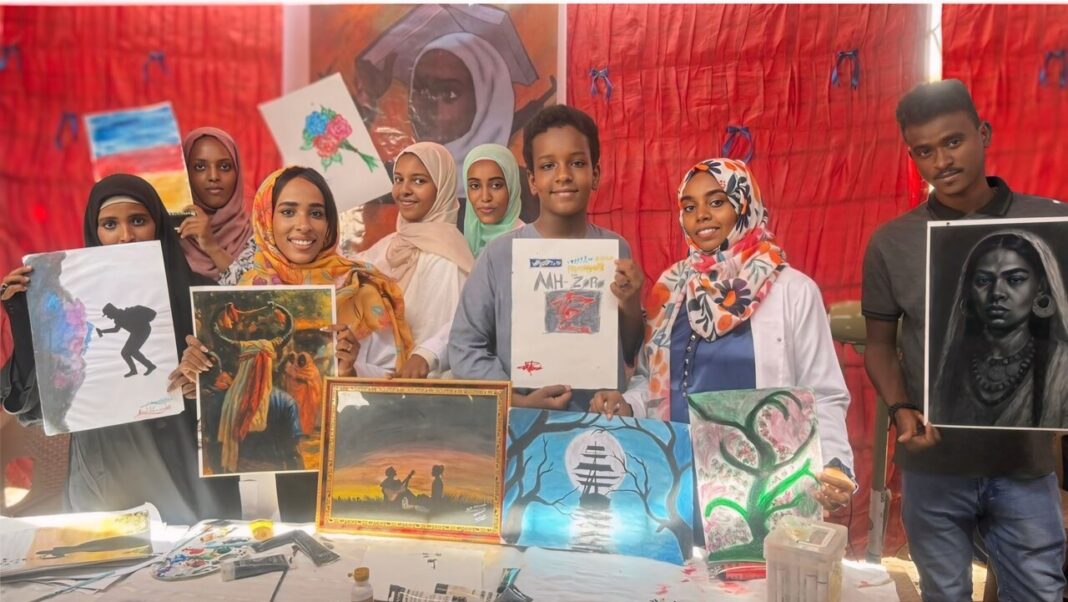
For many Sudanese forced to leave their homes, everyday acts have taken on new meaning. Reshaping their lives, learning a new language, seeking employment, or raising children in new places becomes a quiet defiance against the chaos that tried to break them.
There are over 2 million Sudanese refugees in neighboring countries like Egypt, Chad, South Sudan, and Ethiopia, and another 10 million displaced internally across Sudan, according to the IOM (2024). Many have managed to find employment, continue education, or start new businesses. Some have even launched community-led support groups or Sudanese cultural centers abroad, not just to survive, but to carry Sudan with them, and pass it on.
“We always carry Sudan with us, no matter where we are. We speak our dialects, we cook our food and we tell our children stories about their homeland,” said Abdulazeem Noor, a 40-year-old furniture store owner now working in the UAE.
Each action they take to better their lives, lessons they learn, conversation they have, and traditional meals they make and share is creating moments of normalcy in lives that feel different from everything they have known.
“I may have lost my store, but I didn’t lose my skills,” said Abdulazeem. “One day, I’ll return back to Sudan and start again.”
The hope persists and becomes stronger and more tangible every time they make plans for the future regardless of the uncertainty; it actively resists the chaos that tried to leave them defeated but never could.
Moving forward and rebuilding home
More than 850 days have passed since Sudan was forced into its greatest misfortune. But those days are not just a tally of suffering; they are also proof of survival.
Survival has taught the Sudanese something powerful: that rebuilding the Sudan they know and love is a journey taken wherever they are, and it is one that starts long before they set foot back on its soil. It is reinforced by the experiences they live, the skills they sharpen, and the communities they form in exile. So when the chance to return comes, they will not simply rebuild what was lost; they will also build something so powerfully new, which is a Sudan shaped by the pain they endured, the strength they discovered, and the hope they refused to surrender.
Sara Hassan is a doctor by training, a storyteller by instinct, and a chatty bookworm by nature. Whether she’s dissecting complex ideas or telling stories that matter, she brings warmth, wit, and a sharp eye for the human experience. With a love for writing and a knack for starting deep conversations in unexpected places, Sara writes to connect, question, and spark something real.

Sara Hassan is a doctor by training, a storyteller by instinct, and a chatty bookworm by nature. Whether she’s dissecting complex ideas or telling stories that matter, she brings warmth, wit, and a sharp eye for the human experience. With a love for writing and a knack for starting deep conversations in unexpected places, Sara writes to connect, question, and spark something real.