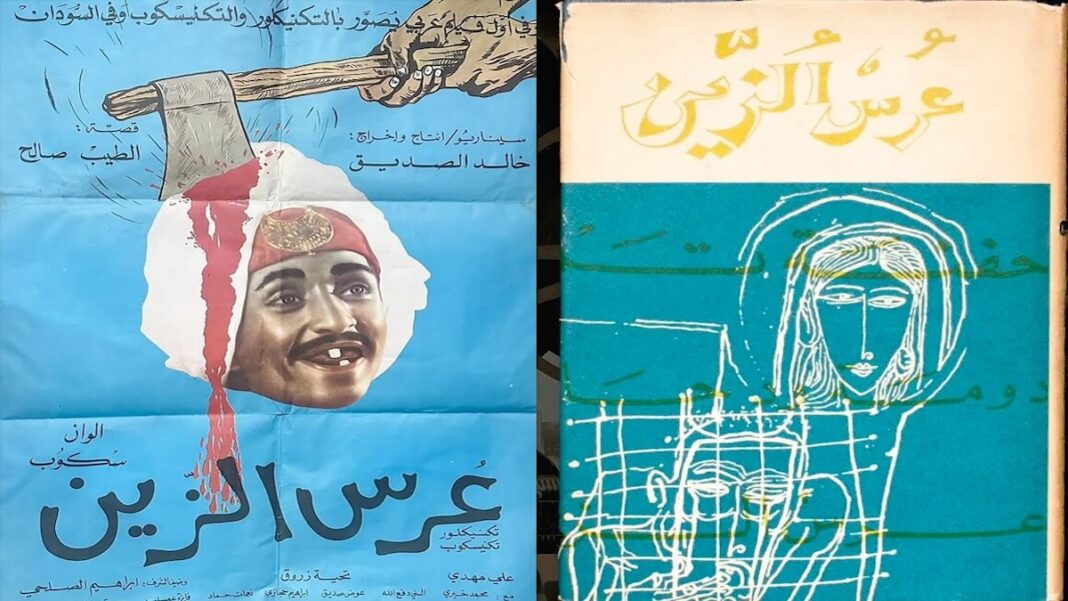
Left-to-right: the original 1976 film poster for The Wedding of Zein, and the cover of the 1968 edition of The Wedding of Zein novel, illustrated by Ibrahim Al Salahi. Sources: vintage_collectaron Instagram & Left Bank Books NY
The practice of adapting literature for the screen is known throughout world cinema, and Sudanese film is no exception.
While it may seem like a way for filmmakers to save themselves the work of writing an original screenplay, the reality is, making an effective film adaptation requires highly creative use of the source material. This very challenge makes screen adaptations exciting. New, inventive interpretations of classic stories can thrive thanks to the possibilities and limitations of the cinematic format.
Whether it be the folktales woven by Sudanese grandmothers, or stories written by Sudanese and non-Sudanese authors alike, Sudan’s filmmakers have been taking on the challenge of adapting literature for over 50 years.
This is an overview of the results: a look into some of the most prominent Sudanese literary adaptations, with thoughts on their relationship to their source material.
The Wedding of Zein (1972)
Few Sudanese books are better known than Al Tayeb Salih’s The Wedding of Zein (1968), the classic comedy about one village’s most eccentric resident and his upcoming marriage. Kuwaiti director Khaled Al Siddiq was inspired to adapt the novella, an idea Salih heartily approved after seeing his work.
The Wedding of Zein (1972) was a major achievement in Sudanese cinema, acclaimed by critics and audiences, including the author himself. At the same time, true to the demands of a visual medium, Al Siddiq’s film is much simpler than Salih’s story, excising the side cast and social commentary to focus on Zein’s character and slapstick. While its significance can’t be downplayed, I personally think the book is a stronger work of entertainment.
Runtime: 74 minutes
Available on: YouTube
Tajouj (1977)
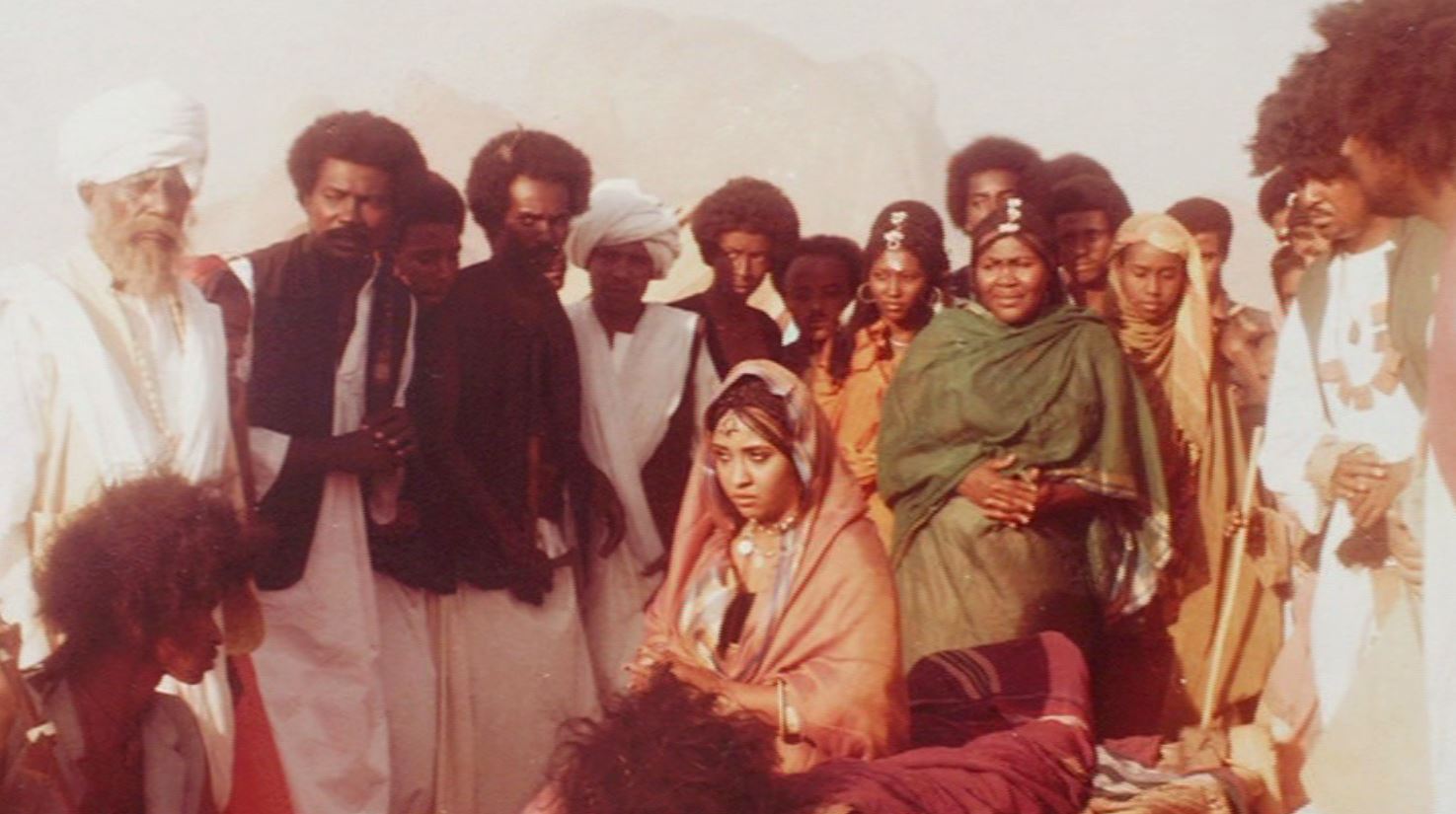
Photograph of the cast of Gadalla Gubara’s Tajouj. Source: Wikimedia Commons
Tajouj is one of the great Sudanese folktales, and the basis for pioneering filmmaker Gadalla Gubara’s first feature film, a one-of-a-kind production, representing Sudanese cinema’s first historical romance.
Considered a masterpiece of early Sudanese cinema, the film is characteristic of Gubara’s directing style, which prioritised authenticity by shooting on location, employing natural lighting, and utilising improvisation over scripted performances. The film is a must-watch for its historical impact, but the emphasis on realism shows in repeated dialogue and drawn out scenes recording cultural traditions that distract from the central narrative, an issue absent from oral and written versions, such as playwright Khalid Abou Al Rus’s 1933 theatrical production, or scholar Abdalla Eltayeb’s 1978 folktale collection.
Runtime: 92 minutes
Available on: YouTube (missing 14 minutes)
Tigers Are Better Looking (1979)
Singer, painter, and director Hussein Shariffe’s third short film is an adaptation of the 1962 short story “Tigers Are Better Looking” by Creole novelist Jean Rhys, one of the most celebrated British novelists of the 20th-century. Whereas Wedding and Tajouj were straightforward adaptations of their source material, following the same plot, Tigers is emblematic of a different approach. The film rewrites the Britain-centered source material as a rumination on Sudanese diaspora life, leading to an abstract, poetic short that is more Shariffe than Rhys.
Runtime: 20 minutes
Not available for streaming.
The Sheikh’s Blessing (1998)
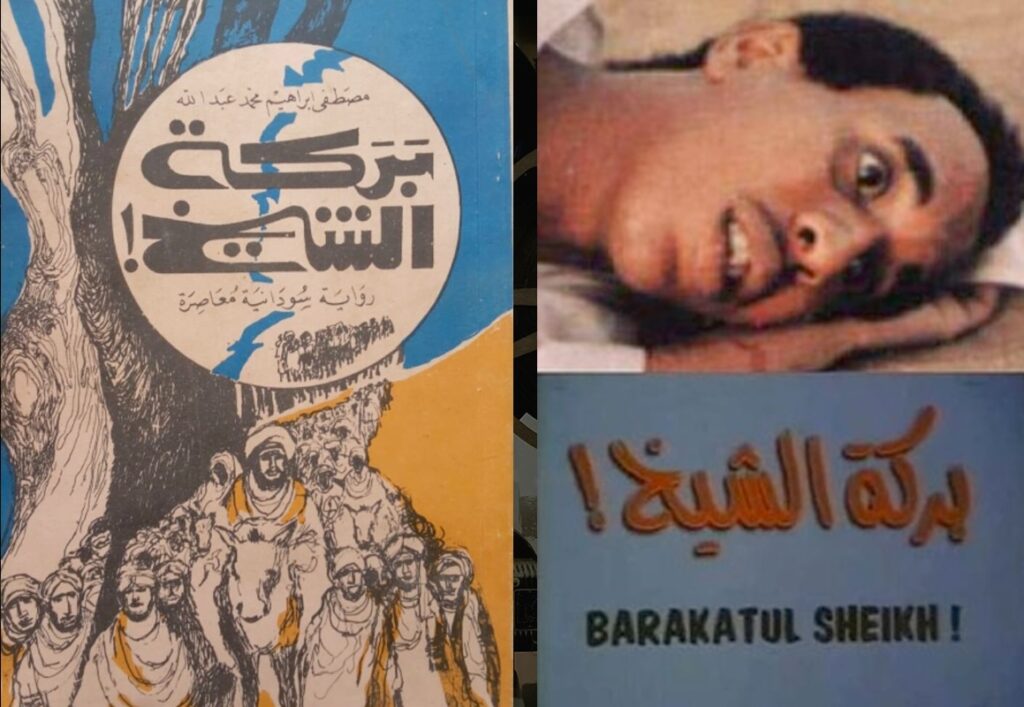
Left-to-right: Cover of Mustafa Ibrahim’s novel the Sheikh’s Blessing, and a poster for Gadalla Gubara’s film adaptation. Source: Goodreads & IMDb
In his introduction to The Sheikh’s Blessing! (1984), Sudanese author Mustafa Ibrahim argued that “successful art exposes the contradictions in reality.” Seeing Gadalla Gubara’s emphasis on realism, it’s logical he chose to adapt a novel written with this sentiment, a story that is part drama, part murder mystery, and part satire of rural Sudanese Sufism.
Although Ibrahim’s book is hard to find these days, Gubara’s film has been preserved by internet archivists. Despite its overshadowing by Tajouj (1977), I find The Sheikh’s Blessing! (1998) to be a much stronger film and adaptation. While a bit slow for modern audiences, patient viewers will be rewarded with an entertaining exemplar of the irreplicable style of 20th-century Sudanese film.
Runtime: 114 minutes
Available on: YouTube
Les Misérables (2007)
Gadalla Gubara said French author Victor Hugo’s famed story of a man imprisoned for stealing bread for his starving family, found in his 1862 novel Les Misérables, “can happen to any Sudanese.” Thus, after five years of dreaming, he adapted the film in collaboration with his daughter Sara in 2006 as his final feature film.
Like Shariffe’s “Tigers,” the Gubaras’ Les Misérables resituates its source material in the Sudanese context. Considering the film’s length compared to the book’s, it is likely the side plots were elided, similar to Al Siddiq’s Wedding, but this is speculation, as I’ve yet to see the film, which is held in Sara Gadalla’s personal archive, with access mediated by German film institute Arsenal Berlin.
Runtime: 112 minutes
Not available for streaming.
Fatima the Beautiful (2017)
This rare example of a Sudanese stop motion film, directed by Mai Elgizouli, adapts the folktale “Fatima the Beautiful,” in which Fatima flees her village to avoid an unsuitable suitor and soon meets her true love. As discussed in a previous Sudan on Screen piece, Elgizouli’s retelling differs from most versions of the folktale for its lack of violent episodes and condemnation of male shallowness. The result is a more family friendly retelling promoting a message typically absent from Sudanese folktales.
Runtime: 6 minutes
Available on: YouTube
You Will Die at Twenty (2019)
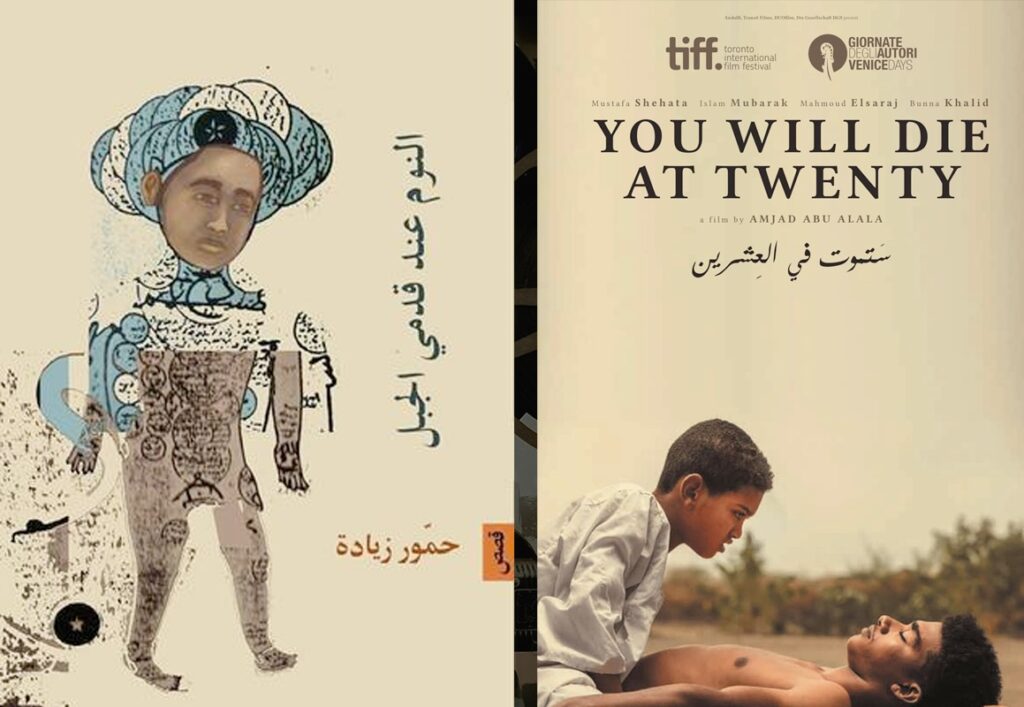
Left-to-right: Cover for Hammour Ziada’s short story collection Sleeping at the Mountain’s Feet, and the poster for Amjad Abu Alala’s You will Die at Twenty. Source: Goodreads & IMDb
Director Amjad Abu Alala was moved when he read Sudanese author Hammour Ziada’s short story “Sleeping at the Mountain’s Feet” after the death of his grandmother. He fell in love with its protagonist, Muzammil, a boy told by a Sufi sheikh that he will die when he turns 20. The result was his first feature film, one of the best-known and most controversial Sudanese films to date.
Aside from the broad strokes of the plot, the short story and film differ fundamentally in their philosophy and characterisation. Ziada emphasises Muzammil’s father, and presents Muzammil with a devout, but unorthodox Muslim mentor figure in Suleiman. Abu Alala’s film focuses on Muzammil’s mother, and rewrites Suleiman to an overtly anti-religious perspective. The film and short story also have radically different endings, making them fascinating to compare. Even if you don’t like the film, the short story is still worth the read.
Runtime: 103 minutes
Available on: YouTube Movies & TV
A Handful of Dates
“A Handful of Dates” is one of Tayeb Salih’s earliest short stories, a psychological exploration of a Sudanese child discovering their grandfather isn’t the hero he thought they were. Sudanese-Mexican director Hashim Hassan, while revisiting Salih’s work after graduating film school, felt the story fit the short film format, intrigued by its exploration of “wealth accumulation in a traditionally religious society.”
Of the two film adaptations of Salih’s work, I feel Hassan’s “Handful” better delivers the dreamlike atmosphere of Salih’s work than Al Siddiq’s Wedding, thanks in large part to its warm cinematography. However, like Al Siddiq’s film, changes were made for the cinematic medium. Namely, the protagonist’s inner monologue, the center of Salih’s story, was left out, creating a more ambiguous story carried by facial acting.
Runtime: 11 minutes
Not available for streaming.
The Future of Sudanese Screen Adaptations
Sudanese filmmakers still look to the world of literature for inspiration, as evidenced by Abu Alala’s announcement of an upcoming adaptation of fiction writer Abdelaziz Baraka Sakin’s Messiah of Darfur (2012). Why shouldn’t they? Sudan is home to many great storytellers, recording, in their own unique way, different Sudanese experiences. Non-Sudanese authors can also have their work transformed to shed light on aspects of Sudanese life that resonate globally and perennially. We also live in an era where long-form reading is less common as a hobby, with visual media and short-form content taking priority. Screen adaptations may help promote the classics of Sudanese oral and written literature. Speaking personally, I would not have encountered the story of Tajouj or the writings of writer and journalist Hammour Ziada, if not for Gubara and Abu Alala.
However, this column is meant to promote conversations about Sudanese cinema that are both in-depth and critical. Thus, I must ask: in the process of adaptation, how much of the stories’ complexity is preserved? Changes for the screen are necessary and inevitable, but does that entail the reduction of The Wedding of Zein to a slapstick comedy, or the mystical “Sleeping at the Mountain’s Feet” to yet another Sudanese anti-Sufi film?
Unlike literature, cinema has the power of the image, capable of viscerally impacting us in a way words cannot. At the same time, requiring a story to be visually interesting and consumed in one sitting — all while remaining under budget — has often led to the reduction of literature’s more challenging, nuanced, and uniquely Sudanese elements.
As a result, I would push Sudanese filmgoers to read, to value fiction, and to take each Sudanese screen adaptation as the opportunity to explore, in even more depth, our country’s oral and written literary heritage.
500WM Columnist Hatim Eujayl is a Sudanese-American writer involved in various projects to promote Sudanese culture. His most famous works include the Sounds of Sudan YouTube channel, the Geri Fai Omir Kickstarter, and the Sawarda Nubian font. More of his writing can be found on his Substack, ‘My Sudani-American LiFE,’ where he discusses Sudanese literature and cinema. He can be reached on Instagram @massintod or by email at [email protected].