Spoiler Alert: This post contains significant spoilers for the series Haneen and Ghareeb.
In the fifth episode of the Sudanese YouTube Ramadan hit series Haneen by popular Sudanese actor, singer and director Ahmed Aljiger, fans are quickly taken into the darkest episode of the month-long series. Ironically, it is the most-watched episode of the series, gaining over 400,000 views.
Fans of the show were confronted with the first depiction of a rape scene in a Sudanese production, though it was not shown explicitly. This carries significant weight and impact, particularly as Haneen is watched by around 300,000 people daily during the month of Ramadan. For many, this may be their first time encountering such a scene, as most Sudanese productions historically adhere to the country’s conservative and modest cultural values. The prevailing notion has often been that while these tragedies occur, they should not be screened for public viewing.
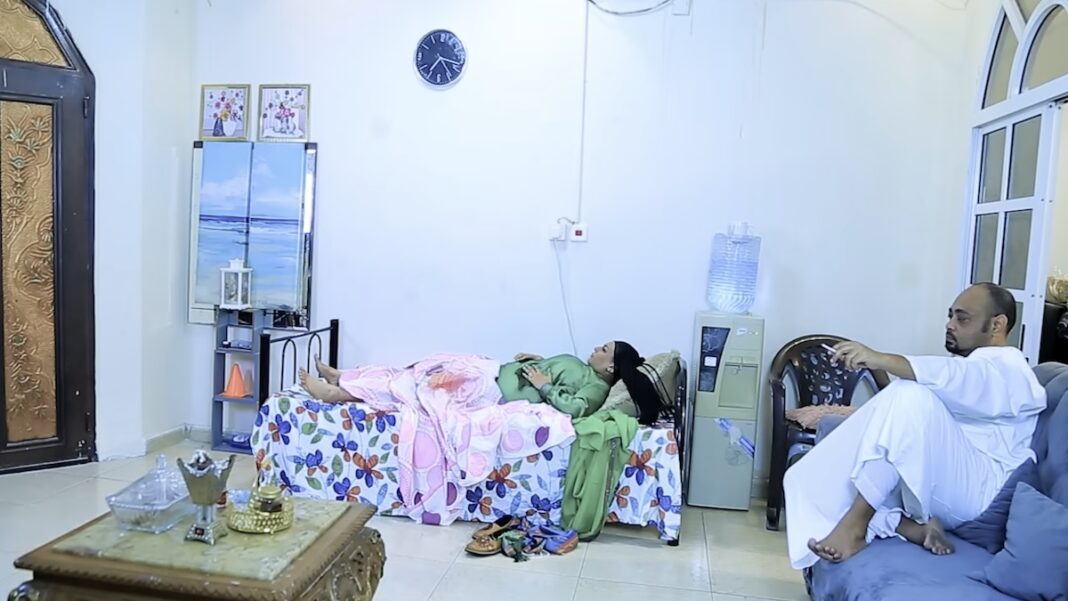
Escaping a forced marriage to a drug dealer arranged by her brother, the lead character Haneen (played by Ruba Kamal) falls into a trap. She is deceived by the feigned kindness of Jalal, a psychopathic rapist and killer played by Amjad Altayeb. Disguised as a kind elderly man, Jalal tricks her into coming to his home under the guise of staying with his non-existent daughters. After offering her drugged juice, Haneen falls unconscious.
While the assault itself is not shown on screen, the aftermath is clear: Haneen wakes up partially uncovered, in pain, and bleeding. Sitting nonchalantly beside her, Jalal admits to the rape and tells her he will hold her captive for as long as he wishes. Following a period of hysterical grief and several attempts to escape, she finally manages to flee as we seen in episode seven. Then that was it. Nearly 25 episodes in, we never see Haneen talk about it, or seek or find justice, something we, especially as women, need to see addressed, carefully and properly. As a loyal fan, I waited to see if it would eventually be dealt with. Yet, in the most recent episodes (23 and 24), we instead see the rapist, Jalal, falling into a trap set by Haneen’s roommate, Nisreen, who tricks him into marriage to steal his money.
The trauma is hinted at but never truly addressed: once when Haneen cries while lying to her father about being hurt; again when she shares her story with a helpful new roommate but omits the assault; and most notably when she panics during a forced vaginal test when a newborn is discovered dead in the girls-only dorm. Despite these moments, the narrative silence remains.
To continue the storyline without properly addressing her rape is extremely problematic, as rape is a major issue in Sudan and across the world, especially during the ongoing war in Sudan, where there are over 1,000 reported rapes cases of women and children since it began in 2023. Haneen is portrayed as a character with exemplary moral values; she is god-fearing, socially respected, and dutiful to her parents. Therefore, when she is raped, we should naturally see her do more than simply “move on.” The shame alone would have destroyed her.
Simply moving on from the assault suggests that rape is normal or is being normalised. Portraying rape in Sudan, no matter the format, and especially in this new era of film and series with many “firsts”, requires a much deeper, more serious, and more impactful delivery. It comes with great responsibility.
The scene was even more poorly delivered due to weak acting. Altayeb’s portrayal of a psychopathic rapist and killer is light and, at times, ridiculous, often causing us to laugh at him rather than fear him. While his effort to portray a menacing Jalal is evident, the execution simply does not land. Although Kamal is a relatively good actress and delivers emotions well in most cases, such as after Haneen’s father dies, she failed to deliver the proper emotional depth required for such a serious scene and topic. Women respond to rape in various ways; there is no single way. However, the way Kamal delivered did not land. The director, Aljiger, is equally at fault for writing and directing such a poorly delivered scene and the sequences that followed.
Aljiger has frequently tackled big, controversial, and sensitive matters in his Ramadan series over the years. However, he consistently addresses these complex topics in ways that prove to be damaging or detrimental. In his other YouTube series, Ghareeb (which he also stars in), he addresses the issue of child rape in the worst way possible. Playing the lawyer Fahad, he is approached by a woman claiming to raise a case against a man for raping her son. He takes the case, only to discover the woman was lying and had accused the man of rape simply because he rejected her advances. This scene is likely the first time child rape has been raised in a Sudanese production, only for the narrative to completely dismantle its severity. The storyline is nothing short of disturbing and disgusting, making the episode and the following sequences very hard to watch.
While false rape allegations do occur and can inflict severe, long-lasting damage, including social stigma, reputational ruin, and psychological trauma, even after an acquittal, they are statistically rare. Portraying such a narrative is extremely problematic and damaging in a society, especially for women and children, that is already suffering legally, socially, and mentally with reporting sexual violence and finding justice. This is called narrative negilence. The series introduces child rape but uses it as a narrative device that is then minimised or dismantled, and risks reinforcing harmful myths. These myths, such as the idea that false rape allegations are common, can actively discourage real-world survivors from seeking help due to fear of disbelief or judgment. It also further pushes the false belief that women commonly fabricate rape claims, when in reality, most women and children do not report such crimes at all, as we see in the case of Haneen. The portrayal of a rare false allegation undermines true victims by fueling skepticism; as a result, it could hinder the pursuit of justice and create further hurdles for reporting legitimate assaults.
Furthermore, in addition to making a false rape claim, the woman is portrayed as “loose” and “scandalous.” This negative depiction is reductive and deeply demeaning to women.
The series is not over yet, and it is possible they may still address Haneen’s trauma or see her achieve justice. However, even if they do, the rape was already handled poorly, and the damage has been done. As I have noted in a previous column, films and television do not necessarily need to portray true stories of Sudanese life; that is not their sole purpose. However, when handling sensitive and critical topics like sexual violence in a society where survivors struggle to find justice, creators carry a major responsibility. They have a significant ethical responsibility when tackling sexual violence, as their portrayal directly influences public perception, especially when the audience includes survivors of similar trauma. Aljiger and his cast have not only failed that responsibility, but they have also missed a chance to make a positive impact on a critical societal matter.

Ola Diab is the new founder and editor of 500 Words Magazine, and the deputy editor of Marhaba Information Guide, Qatar’s premier information guide. Based in Qatar, the Sudanese journalist graduated from Northwestern University in Qatar (NU-Q) in 2012 with a Bachelor of Science in Journalism and has since built a successful career in the print and digital media industry in Qatar. Find her on X (formerly Twitter) @therealoladiab or on LinkedIn.