

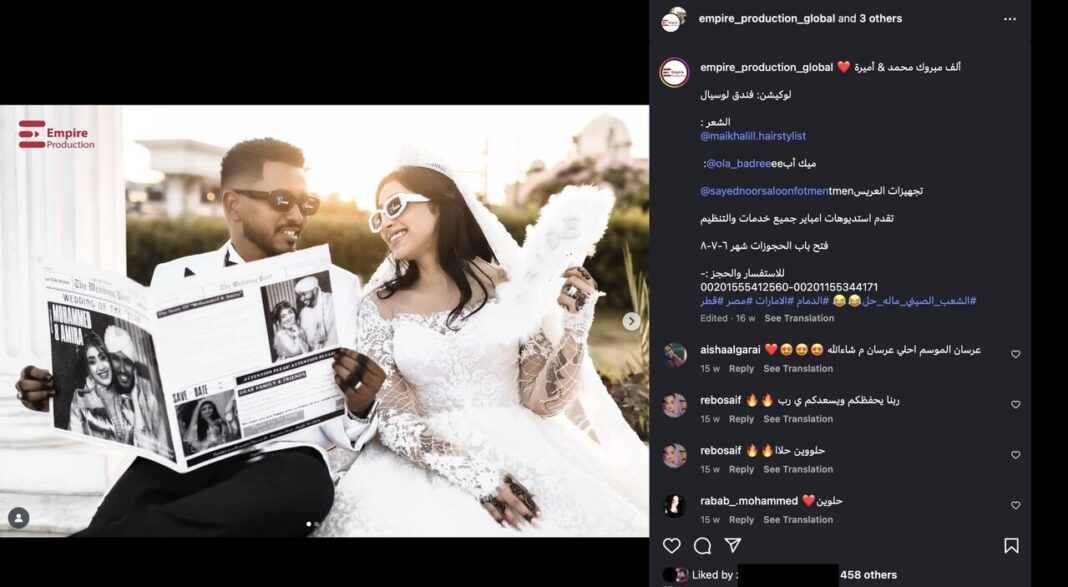

The winter wedding season, typically December and January, is almost upon us. Along with it comes a flood of beautiful wedding photos from people we may or may not know. And with those photos inevitably comes a wave of comments, some kind, and others not so much.
Recently, a photographer shared pictures and videos from a photoshoot of a Sudanese bride and groom living in the diaspora. The posts quickly went viral, not because of their quality, but because of how the bride was dressed and the couple’s display of intimacy in the photos. Out of respect for the newlyweds and for the purpose of this article, images and links to the photos will not be included.
The couple wore traditional jirtig attire. The jirtig is a traditional Sudanese wedding ceremony involving spiritual practices meant to bless the union. During the ceremony, the bride typically wears a red toub, adorned with gold jewellery, while the groom wears an off-white jalabiya, both specific to the occasion.
In this particular photoshoot, however, the bride wore a short jirtig dress without the toub, which is uncommon and sparked anger among many viewers. The photos circulated widely across various platforms, with people sharing their opinions, both supportive and critical.
Until recently, it was uncommon, almost taboo, for Sudanese people to share their weddings on social media. Although some still view it as unacceptable or against cultural norms, the practice has become increasingly common, and in some cases, even expected. This shift is largely due to the rapid growth of social media and its influence on younger generations, who regularly post aspects of their lives online — from food and travel to weddings and even funerals. Additionally, the trend is driven by wedding photographers, videographers, and makeup and beauty artists who push social boundaries by showcasing their work on social platforms to promote their businesses.
As with most things on social media, wedding posts often attract negative comments, even on what should be people’s happiest day. At times, photos from these celebrations go viral, drawing harsh criticism and unkind remarks from strangers the couple neither knows nor will ever meet.
Weddings, no matter how large, are inherently private. However, in Sudan, there is a common notion that weddings are public events — open to anyone and everyone. This perception stems from the scale of Sudanese weddings, which often host around a thousand guests or more. Traditionally, weddings are not by formal invitation, where RSVPs or confirmations are required. Although this practice is slowly becoming more common, it is still viewed by many as “non-Sudanese.” In most cases, wedding invitations are treated as open invitations. When looking back at their wedding day, many Sudanese couples realise that they do not know, or even recognise, a large number of the attendees. The idea of inviting someone with a “+1” is, in Sudan, more like inviting them with a “+2,” “+3,” or even “+5.” Guests who do not personally know the bride and groom, or their families, often feel comfortable attending, documenting the event, and sharing photos or videos online.
So, who is responsible, or most responsible, for what happens online? Is it those who post, those who share, or those who comment? Or is it all of the above?
Those who post?
Least responsible.
Whether those who post the pictures are the couples themselves, their families or friends, or the photographers or singers they hired, it is their choice to share. However, the approval or permission from the newlyweds themselves is necessary and most important. Digital consent is often overlooked in Sudanese digital spaces.
A line is crossed when the person posting has no relationship with the couple and takes the pictures from another source to post on their own platform for personal purposes, whether good or bad.
If the newlyweds are comfortable with pictures and videos of their wedding being shared on social media, they must be ready for all the comments and criticism that may follow, including the most unsolicited and unwarranted. Once shared online, the line between private and public becomes blurred. What was private can quickly become public, and uncontrollably so.
Those who share/reshare or repost?
Definitely responsible.
There should always be caution when sharing or resharing others’ content — whether words, pictures, or videos. It comes with great responsibility that many seem to forget simply because it’s just a button that can be easily and quickly pressed. A share can add fuel to an already burning situation, causing more damage. Sometimes, a share can act like gossip, passing talk from one person to another. As mentioned above, and to reiterate, digital consent is often overlooked in Sudanese digital spaces. Consent doesn’t end at the moment a photo is taken; it extends to where, how, and by whom it’s shared.
In a column piece I wrote in August 2025, titled A Right to Privacy: Trust, Consent, and Sharing, I addressed this and discussed the importance of respecting the privacy of individuals’ online activities and personal content. I wrote about the right to privacy and the right to publicity — both of which are at risk when we’re online. Therefore, everyone should be aware of their digital or cyber rights to ensure they are protected and do not breach the rights of others.
Those who comment?
Most responsible.
or many, commenting on what we see online has become a common practice — whether for personal, professional, or simple engagement purposes.
But sometimes, the comments we make can be toxic, destructive, and even amount to bullying, as I discussed in my previous column Addressing Online Bullying and Destructive Criticism in Sudanese Digital Spaces. Such comments, especially on wedding pictures, can be deeply hurtful and can ruin what should be the couple’s happiest day. While social media can amplify negativity, publicly posted wedding photos can allow loved ones who could not attend to celebrate the milestone, and allow non-Sudanese family and friends to see Sudanese cultural traditions.
When these pictures are shared online, we tend to treat them as public affairs, as though we were invited to them. We forget that what has become public and accessible to us originally took place in private, among family, friends, and loved ones. We often forget that behind the photos are real people with real emotions. Screens, whether on mobiles, computers or any other devices, create a distance that dulls our empathy, but we must consciously bring it back.
To comment beyond congratulations, with criticism or questioning, can be unnecessary and unwarranted. We have full control over the words we choose to comment with, and the impact we leave behind, whether good or bad, is our complete responsibility.
So, exercise mindfulness and empathy. Consider the feelings of the person you are addressing. As the saying goes, “Think before you speak.” In this case, “think before you post, repost, reshare, or comment.” We are all entitled to our opinions; however, we are not entitled to share them. Remember, if you don’t like someone’s wedding pictures — whether you know them or not — you can always simply ignore them, look away, and move on.

Ola Diab is the new founder and editor of 500 Words Magazine, and the deputy editor of Marhaba Information Guide, Qatar’s premier information guide. Based in Qatar, the Sudanese journalist graduated from Northwestern University in Qatar (NU-Q) in 2012 with a Bachelor of Science in Journalism and has since built a successful career in the print and digital media industry in Qatar. Find her on X (formerly Twitter) @therealoladiab or on LinkedIn.