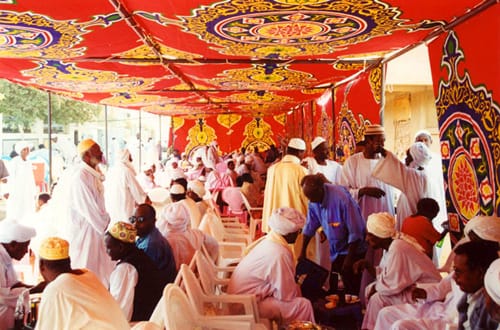
Image credit: Flickr weddingssc6
A few days ago, I was on a call with a dear cousin. As we talked and caught up, I began to complain about the many family and social obligations eating up my time and leaving me exhausted. “We do too much,” I said, speaking specifically about us as Sudanese, implying that it’s more of a burden than a blessing, and that maybe it should change. She replied, “But wouldn’t we take away part of what makes us Sudanese?” Her words deeply resonated with me, enough to move me to write this. I felt conflicted, torn between personal preferences, culture and tradition, and identity.
Later, I began to wonder: how did we, as Sudanese, become such socially obligated people? When and how did it start? And if we were ever to become less social, how and when would that happen? Most importantly, can we find a middle ground between doing too much and doing too little — a place where we’re doing just enough?
For me, it all started with how I was raised. I grew up in an environment where family and social obligations were at the heart of everyday life. That environment was shaped, first and foremost, by my very social and hospitable parents, who are people driven by a deep sense of responsibility toward others and our extended family. Although I grew up in the diaspora, away from Sudan, I still adopted many deeply Sudanese practices and values. My family placed great importance on preserving our culture and traditions, so from a young age, I joined my parents at all kinds of gatherings — the necessary and the unnecessary — births, funerals, weddings, family trips, and simple home visits. Over time, that sense of duty toward others became a part of me too. Often, whenever I receive an invitation or sense an expectation to attend, I feel I must be there.
Ironically, I often tell my mother and other elders in the family that they are doing too much, and that their constant exhaustion is proof of it. I argue that at their fragile age, they should slow down and prioritise their well-being. “At this age, no one will blame you for not being there. And if they do, they’re narrow-minded,” I say. Their responses are usually the same:
- “You should know better.”
- “Then who will be there for us when something happens to us?”
- “You’re right, but what can we do? We have to be there.”
And so, we return to our routine — the exhausting cycle of social duties that rarely pauses. This highlights several deeper issues:
- We often attend or perform social obligations out of duty rather than sincerity
- We feel compelled to do so until the end of our lives
- We struggle to change our ways
- We consistently put others before ourselves — among many other challenges.
Unconsciously, I’ve been doing the same with my children — a habit encouraged by those around us, whether close or extended family members or acquaintances. The advice is always the same: bring the children often so they become more social and friendly, so they know their family, their people, their culture, and their traditions. I do this so frequently that my son, at just two years old, once raised his hands to perform Al Fatiha, a Sudanese practice during a bikka or ‘azzaa (funeral service), where one raises both hands in prayer at chest level to recite Surah Al Fatiha when offering condolences to the bereaved. At first, I, along with those who witnessed it, found it humorous. But later, I began to feel guilty and even irresponsible for bringing him into such spaces and exposing him to these practices at such a young age. Yet often, I have no choice but to bring him, or now, his sister, because there’s no one else to care for them while I’m away. And that’s the case for many mothers. As many know, during times of mourning or any other occasion where your presence is expected, there are no excuses. One must be there, no matter the situation.
As I stated in a previous column piece, “Society, Culture and Tradition Above All: More Sacred Than Life Itself?”, for Sudanese people, fulfilling family and social obligations “is a core cultural value, rooted in the people’s deeply hospitable nature and strong sense of responsibility toward others and their well-being. Neglecting these social duties, values, and norms is often viewed as un-Sudanese and as a breach of expected social values and behaviour, frequently resulting in criticism, accusations, or even social ostracism.” Known as mujamalat, which roughly translates to “social niceties,” “courtesies,” or “polite gestures,” social obligations such as zeyara (visit), zeyarat (visits), ‘eris (wedding), bikka or ‘azzaa (funeral), and semaya (birth celebration) are part of everyday vocabulary.
However, there is beauty in all of this. Some say their love and sense of duty toward social obligations make them feel no pain or exhaustion because, for them, it’s fulfilling. Others admit it can be tiring, even painful at times, yet there’s still joy and comfort that balance it out. As they say, they find beauty in the pain. That beauty lies in the fact that no one is ever truly alone — not during occasions, nor in ordinary days. People always show up, and they show up in numbers. There’s an unspoken rule: “I’ll be there for you, and you’ll be there for me.” It’s an understanding that most abide by, and those who don’t often find themselves left behind or quietly excluded.
In countries where Sudanese communities are large, such as Egypt, Saudi Arabia, the UAE, Oman, and Qatar, it’s nearly impossible to escape social obligations, and for those with family in the diaspora, family obligations as well. However, in places where Sudanese communities are smaller, particularly in non-Arab countries such as the US, the UK, Canada, or Australia, these expectations may not be as pressing, or may not exist at all.
In fact, for Sudanese living in Arab countries, there is a shared understanding of family and social obligations, as both cultures are known for their courtesy and hospitality. This similarity can also be found in parts of Asia, Africa, and even Eastern Europe. However, even within Arab communities, our level of commitment to family and social duties is often seen as unparalleled — a sentiment I’ve heard echoed by people of various nationalities, many of whom have also noted how exhausting it can be.
For instance, in many Arab cultures, ‘azzaa (funeral gatherings) are formally announced with a set location, date, and time. In Sudanese culture, however, although this practice is slowly becoming more common, such formality can still be seen as discourteous, audacious, or even un-Sudanese. Traditionally, mourners are expected to keep their doors open at any hour and on any day to receive condolences. Guests, especially close ones, may stay for hours or even days, often returning again and again to check on the bereaved, bringing food and refreshments entirely of their own accord. This spirit of generosity extends beyond mourning; the same openness and sense of duty are shown during any occasion, from funerals to births to weddings.
When I speak with family members who found a temporary home in Egypt after being displaced by the war that began in Sudan in April 2023, they all share a similar sentiment: “It’s like we are in Sudan,” they say, referring to being surrounded by family and friends and continuing the life they once had in Sudan — an eventful life full of social obligations. They experience the same exhaustion, if not more due to their current circumstances, alongside the same joy, celebrating togetherness in the good, the bad, and even the ugly.
As a people who hold culture and tradition in high regard, we need to preserve what is valuable, both as a collective and as individuals, while letting go of what no longer serves us, especially when it comes at the cost of our health and well-being. Yes, we may be doing too much, but that doesn’t mean we should abandon the practices that make us Sudanese. Instead, we must find a balance, honouring our heritage while adapting to the fast-paced, time-consuming world we live in today.

Ola Diab is the new founder and editor of 500 Words Magazine, and the deputy editor of Marhaba Information Guide, Qatar’s premier information guide. Based in Qatar, the Sudanese journalist graduated from Northwestern University in Qatar (NU-Q) in 2012 with a Bachelor of Science in Journalism and has since built a successful career in the print and digital media industry in Qatar. Find her on X (formerly Twitter) @therealoladiab or on LinkedIn.