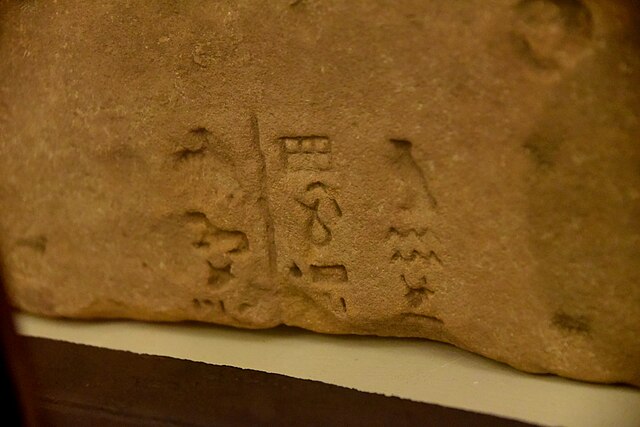

A sandstone block inscribed with the name of the Kushite deity Amani. Source: Wikimedia Commons
Naming practices are always fluid; a name that seemed perfectly normal 50 years ago can be discarded as ism haboba (a grandma name) in the space of two generations. As a result, the naming traditions documented in Sudanese artefacts and oral literature can offer an insight into the various religious, linguistic, and social transformations that preceded modern Sudanese culture.
While the history of the lands now encompassed by the Republic of Sudan is always characterised by diversity and change, there are recurring themes in ancient names that will still feel familiar to a contemporary Sudanese person.
The Kingdom of Kush
The 2,800 years of Kushite rule that began in the third millennium BCE provides the earliest written records of local naming practices. The confidently understood names tend to belong to one of two languages: Egyptian or Meroitic. In 1969, Sudanese scholar Abdelgadir Mahmoud classified the Meroitic names as ‘secular’ or ‘religious’ in content. The majority were compound words, and a 10th made explicit mention of Kushite-Egyptian gods. Most recognisable of these is perhaps Amani, known as Amun in Egypt, referenced in the name of the famed Kushite Queen Amanirenas. French scholar Claude Rilly translates her name as a compound of the words Amani (‘Amun’), are (‘you’), and nas (‘tall’), thus: “Amani, you are tall.”
Comparing her name to other names with secular content, such as Amanikharekwerema (‘Amani, you are black’), Rilly concludes Kushites would sometimes name their kids for physical or behavioral qualities. Upon coronation, ‘Amani’ would be added to their birth names, reflecting their divine royal status.
In regards to the use of Egyptian names, Austrian Egyptologist Julia Budka notes in the Oxford Handbook of Ancient Nubia that non-Egyptian birth names, while near-universal among Kushite royals of the 25th Dynasty, were overall less common than Egyptian names in the record. According to Budka, some Kushites would use both an Egyptian and a Kushite name, such as the Kushite man Penpenaneh, called Pawen in Egyptian. Other Kushite-Egyptian names made explicit mention of their bearer’s Kushite ethnicity, including the name of King Kashata (‘Kushite’).
While the Kushite-Egyptian social context is quite alien to modern Sudanese, Kushite naming themes are not. Naming kids after their physical traits, such as dark skin, continues to be practiced by the Midob tribe in north Darfur. There are an abundance of uniquely Sudanese theophoric names, such as Taj Allah, Jad Allah, Dafa’ Allah, etc. Compound names are also common among older generations, such as Muhammad Ahmed and Sitt Al Banat.
The Christian Nubian Kingdoms

Painting from Faras Cathedral depicting a Nubian bishop with the Greek name Marianos next to a Byzantine-style depiction of the Virgin Mary. Source: World History Encyclopedia
By the 4th century CE, the old order represented by the Kushite elite collapsed, and was supplanted by the three kingdoms ruled by Nubian-speaking, Orthodox Christian elites: Nobatia, Makuria, and Alodia.
Greek and Old Nubian were the most frequently written languages in these kingdoms, being used in religious contexts and economic settings. Consequently, Christian names of Greek origin were common, with examples, including Isu (‘Jesus’) and Maria (‘Mary’). Some Greek names would take on uniquely Nubian forms, evident in compound names containing -foru, a Nubianised form of Greek -phorus, found in names like Teoforu (‘God-bearer’), and names with the element -nkouda (‘servant of’ in Old Nubian), which were often blended with Greek vocabulary, such as in the names Staurosinkouda (‘servant of the cross’) and Gabrilinkouda (‘servant of Gabriel’) .
Despite this pervasive Greek influence, Old Nubian names were still more common overall. Some reflect Christian themes, such as Tuskonkouda (‘servant of the Trinity’) and Jawe (‘gospel’), while others have secular meanings, such as Dollai (‘wisher’) and Mashal (‘sun’).
In the later periods of Christian Nubian history, Nubianised Arabic names begin to appear, including Muhumeti (Muhammad) and Asan (Hasan). Some of these people with Arabic names have Nubian patronyms, such as Ali Dablesongingal (‘Ali, son of Dablesongi’), leading Polish archaeologist Grzegorz Ochała to conclude they possibly represent early Nubian converts to Islam.
A parallel can be drawn between Christian Nubian practices, and the way Nubians continue to combine non-Nubian religious terms with Nubian elements, such as in the names such as Oshalla and Nugudalla (‘servant of Allah’). Likewise, prophets and angels continue to inspire many Arabic Sudanese names, ie ‘Isa and Mikail. Just as Greek names were Nubianised, many Islamic names took on new pronunciations in Arabophone Sudan, ie ‘Asha for ‘Aisha.
The Daju and Tunjur Kingdoms

Ruins of the Ayn Farah mosque, built by the Tunjur sultans in Darfur. Source: Peter Verney
In the 12th century, west of Christian Nubian territory, Daju elites of a non-Abrahamic faith established the first known Darfuri state. This began a state-making tradition that would be followed by the two Islamic sultanates of the Tunjur and the Fur. Compared to Kush and Christian Nubia, there is much less study of naming practices of the Darfuri kingdoms overall, and a dearth of written sources up until the later years of Fur-rule. Regardless, local oral literature, surveyed by American scholar Andrew McGregor in 2000, allows some major themes to be identified.
Modern Daju oral literature, while primarily focusing on recording Daju royal names after the rise of Islam, preserves a handful of names from the pre-Islamic era. These include names of uncertain meaning, such as Kamteinyi, and the epithet Kissifuroge (‘Furoge-eater’), given to the Daju king credited with consolidating the kingdom’s rule by defeating the Furoge tribe.
In the 15th century, the Daju elites were supplanted by Tunjur sultans under unclear circumstances, thus establishing Darfur’s first Islamic kingdom. The Tunjur also did not practice writing, and only a handful of kings’ names have been documented in their oral literature. Regardless, a Tunjur genealogy from Kordofan indicates the sultans’ Muslim background through Arabic names like Ishaq (Isaac). There are only two names of local origin in the genealogies collected by McGregor: Nol (also the name of a Funj Sultan) and Shau Dorshid, depicted as a tyrant in a manner similar to the pagan Daju kings. This may indicate an association between Islam and moral excellence, echoing a trope of unruly, pagan tyrants in Sudanese oral literature.
The Sultanate of Sinnar
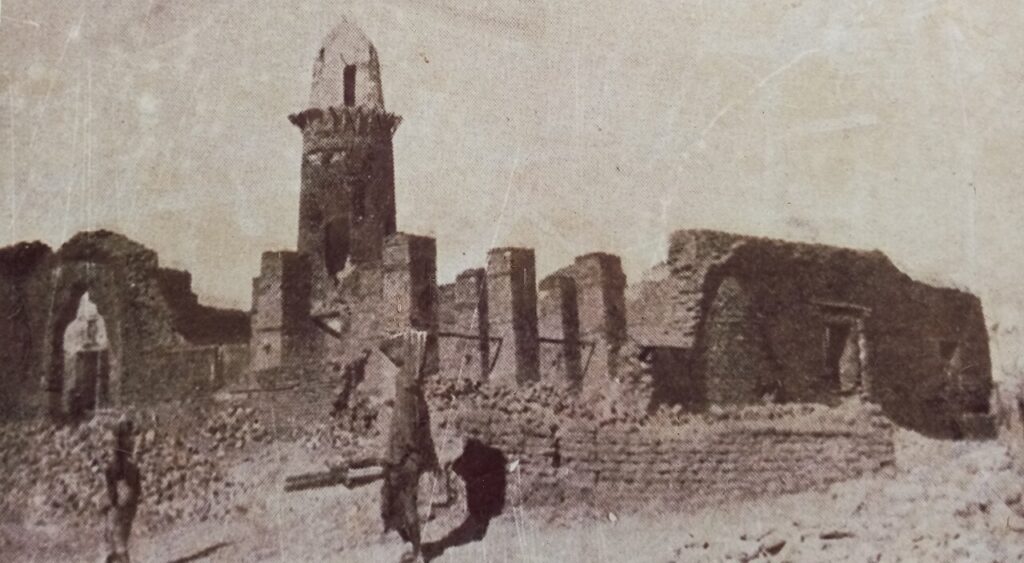
Medieval ruins of a mosque in Old Sinnar. Source: Sudan Archaeological Heritage Protection Project
While the Tunjur state consolidated power in the west, King Amara Dungus consolidated Funj power over former Christian Nubian territory in 1504. The resulting Sinnar Sultanate is remembered for its essential role in spreading Islam and Arabic throughout modern Sudan. Despite this image, however, Sinnari documents indicate that local non-Arabic cultures remained alive and well. According to American scholar Jay Spaulding’s landmark book on Sinnari history, The Heroic Age of Sinnar, while Arabic names dominated among Sinnari nobles, middle-class merchants, and slaves, most commoners had non-Arabic names of local origin. Some show clear affinities with modern Sudanese languages, such as the name Irsod (a Nubian name), most are of unclear origin.
Among Sinnari nobles, such as the sultans or the provincial and district governors who ruled under them, Arabic names (ie ‘Adlan and Diyab) were most common, although some non-Arabic names retained currency, such as Badey, meaning ‘cultivator,’ one of the Sinnari Sultan’s titles. Many of these names endure among elderly Sudanese, even while non-Arabic noble names like ‘Amara and Unsa faded from memory.
The names of Sinnar-era merchants, however, were entirely Arabic, including standard Islamic names like Khalid and local variants like Babikir (for Abu Bakr).
Slaves also primarily had Arabic names, typically in a compound format, often of theophoric nature, such as Allahu Jabu (‘God brought him’). Others would refer to their servile status, such as Kheyr as-Sayyid (‘the master’s best). This points to their masters’ Arabophone background, aligning with the abundance of Arabic and Islamic names among the slave-owning noble and middle classes, in contrast to the commoner class, who had autonomy that enslaved peoples were deprived of, but were simultaneously distant from the elite Arab-Islamic culture.
The Fur Sultanate

Palace of Ali Dinar, the last Sultan of Darfur, in Al Fashir. Source: African History Extra
In the 17th century, Sinnar’s western Tunjur neighbours were conquered by the Fur Keira dynasty, establishing the Sultanate of Darfur, the apex of Darfur’s pre-colonial economic and political influence. According to Fur oral literature, the kingdom was established by Sulayman Solongdungo, ‘Sulayman the red-skinned,’ whose name indicates not only the Keira’s Islamic loyalties, but also their noble Arab pedigree. The majority of Sulayman’s descendants had Islamic names, save for a handful of exceptions like Sultan Kuro.
While written evidence from the Fur Sultanate is not as abundant, the overall picture given is a situation similar to that of Sinnar, where Arabic names dominated among upper classes and their servants, but not necessarily among commoners, who mainly spoke local languages.
Naming practices as a source for pre-colonial thought

An illustration of a man from Sinnar with the Muslim name Ibrahim, who visited Istanbul around 1856. Source: African History Extra
It should not be thought that modern Sudanese practices stem in their entirety from pre-colonial patterns; to say so would be to treat Sudan as an isolated corner of the world, cut off from foreign influence, a notion refuted by the linguistic and ideological diversity in Sudanese names found in every era. Religious names, compound names, and names blending multiple languages are not remotely unique to the region.
Rather, the study of pre-colonial Sudanese naming practices is useful on two grounds. First, it reveals patterns of human behaviour that transcend fluctuating religious, cultural, and linguistic identities.
Secondly, these practices record the values of pre-Sudanese societies, be it the Kushite appreciation for dark complexions and height, to Nubian theologies of spiritual servitude, to Sinnar’s strict class hierarchy, to the Keira’s association of Islam with moral enlightenment. In contrast to seemingly perennial themes, such as the centrality of religion, these practices serve as evidence for a reality obscured by essentialist, nationalist narratives: the ultimate malleability of the ‘Sudanese’ identity.
500WM Columnist Hatim Eujayl is a Sudanese-American writer involved in various projects to promote Sudanese culture. His most famous works include the Sounds of Sudan YouTube channel, the Geri Fai Omir Kickstarter, and the Sawarda Nubian font. More of his writing can be found on his Substack, ‘My Sudani-American LiFE,’ where he discusses Sudanese literature and cinema. He can be reached on Instagram @massintod or by email at [email protected].