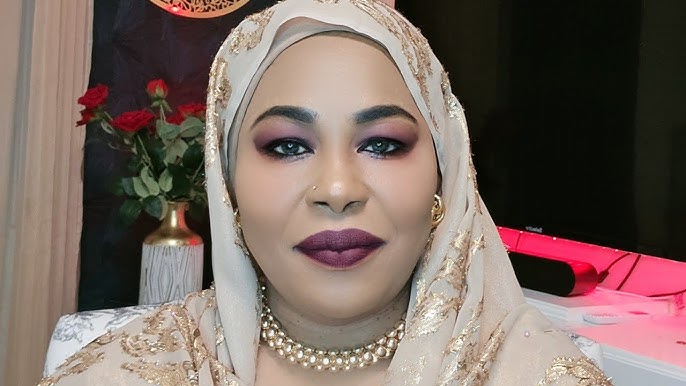

Gold bracelets on her wrists, silk chiffon on her head, and makeup applied like armor, well-known social media personality Kawther Abdalla reigns over her TikTok livestreams like a queen over her court.
Popularly known by the moniker “Mama Kouki” and using the TikTok name @KawtherAbdalla46, Kawther is a Sudanese immigrant living in France who has been producing social media content since at least 2022. In France, TikTok accounts can be monetised to earn users money through views and ad revenue, and as such, Kawther’s TikTok represents her own business venture. But for Kawther’s followers – over a million on both Facebook and TikTok – her livestreamed conversations offer a way to connect with other Sudanese women living in displacement.
Presenting herself as an aunty providing a listening ear, Kawther’s show centers around the anonymous call-ins of her listeners, who describe their life success stories, their woes, and their secret scandals which Kawther reacts to. “She’s our Wendy Williams,” said one TikTok comment, comparing her to the famous African-American talk show host and media personality who was known for her unfiltered commentary on the lives of celebrities. The novelty of the “Mama Kouki” show is the ability for listeners to anonymously present and listen to what are normally extremely private topics – topics difficult to imagine airing on ultra-formal Sudanese TV because of the perception of these topics as “backbiting” / “غيبة” of people’s private lives. However, the anonymous presentation of scandals on Kawther’s livestreams defangs what Sudanese Muslim society usually fears: the destroyal of a person’s honourable reputation through revealing secrets without their consent.
@kawtherabdalla46 Merci pour cette magnifique soirée @TikTok @FestivaldeCannes ♬ original sound – Kawther 🇫🇷
The conversations Kawther hosts often centre topics dismissed by Sudanese men of her social class as mere “women’s talk” / “كلام نسوان” or “gossip” / “قطيعة” – topics seen as not important enough to be addressed on television, radio or other formal public broadcast or platforms. For example: Kawther’s own story of becoming financially self-sufficient in order to separate with her children from her former husband after he took a second wife, the story of woman who boasts that she stole the husband of a woman who stopped her marriage to another, and the story of a husband who cheats with his wife’s best friend on their wedding night. Yet, calling it “gossip” often demeans the power of women’s conversations in private spaces – conversations which are forms of social investigation and policing which Sudanese society relies on just as much as men’s formal conversations in public spaces. Kawther’s TikTok livestreams bring the hidden and suppressed private world of Sudanese families into the public sphere, breaking the proverbial Arabic rule that “homes have their secrets” or “البيوت اسرار” which influences Sudanese home life.
Disturbingly, the secrets that Sudanese listeners call in about – and the way Kawther and her fans respond to them – reveal the social normalcy of devastating levels of violence within the average Sudanese middle class home. Scrolling through her TikTok, one can hear stories of a man forcibly married to his cousin as a teenager, a woman and her children beaten by a patriarch who then tried to have the police kick them out of his home, a particularly ugly story of a child who attempted suicide after her mother did not believe that her father was sexually abusing her, and the list goes on. One recent and extremely horrifying TikTok was about a young woman who defied her violent mother by going out to an all-night party in Cairo, Egypt with her female friends, and upon her return she was stabbed to death by her mother. The comments largely blamed the young woman’s best friend for “provoking” the murderer and “causing” the woman’s death by taking her to the party. Kawther herself went so far as to say that women who cannot be kept from going out should be married off, “like our elders used to do,” to a man who can do whatever he wants to her even “if he throws her into the ocean.”
The stories that shock many on Kawther’s TikTok livestreams are uncomfortable reminders to the diaspora – especially Sudanese men who rarely hear the “whisper networks” among women between different homes – that domestic violence is in fact a staple of Sudanese family life just as it is in other countries. The problem is that the violence of these TikTok stories is rarely commented on negatively by Kawther and her listeners. Instead, this violence is seen as merely a fact of life. In fact, what disturbs many Sudanese who complain about the Mama Kouki show is not the revealed stories of murders, beatings, and emotional abuse, but the fact that they believe these issues are “private family matters” which should not be talked about in public. One person posting on Facebook complained that “she has upended the veil that God has covered Sudanese families with. She shows the worst of the Sudanese people, and she brings out stories that we otherwise never would have heard.”
The privacy afforded to the middle class within Sudan is what allows many like this commentator to effectively hide intra-family violence and deny that it is widespread. Instead, many living within comfortable and happy families will claim it is only “the poor and ignorant” who behave violently – a perception aided by the fact it is the working class who do not have the money to hide their scandals behind closed doors. However, outside of Sudan the Sudanese middle-class rarely have the social capital to make family scandals disappear so easily. They are no longer citizens who can use their connections to make the law turn a blind eye to them. Instead, they are living in a state of precarity where their lives are hyper-visible. At best, their previously “private affairs” become social embarrassments, as seen in the recent TikTok trend of children laughing at the how their Sudanese parents curse them, leaving some older Sudanese in shock and denial that this is normal. At worst, these so-called “private affairs” become publicly prosecuted crimes, as seen in the news of a Sudanese woman and sisters stabbed to death by her ex-husband in Saudi Arabia, which forced Sudanese diasporic women to speak out against a man defending the husband.
The secrets of Sudanese family life revealed in Kawther’s livestreams should serve as a sober reminder of how far Sudanese have to go in eradicating social violence within our communities both at home and in diaspora. While international actors often pay the most attention to the sexual violence of female genital mutilation (FGM) in Sudanese communities, we must holistically address such issues with an eye to their greater context – the widespread occurence of physical violence of family elders against youth and teachers against pupils, illicit sexual abuse of children in family and neighborhood spaces, torture of children in religious schools by teachers, forced marriage of young people for their families’ monetary benefits, competitive and honorific whippings associated with masculinity, domestic and sexual violence by men against their wives, violence against women in public spaces and universities, police brutality against prisoners and the homeless and socially marginalised, and of course, the practices of torture and brutality against citizens and activists by local armed forces. Livestreamers such as Kawther Abdalla have a responsibility to address these issues within themselves and their wide audiences. Otherwise, the social work of a democratic and peaceful Sudan remains incomplete.

Dr Razan Idris is a Sudanese-American writer and postdoctoral researcher of African and Middle Eastern history based in Philadelphia. She is also the curator of the #SudanSyllabus, an open-access project compiling resources on Sudanese social and cultural history. Razan is dedicated to cross-cultural justice-driven storytelling, and she is working on her upcoming book about Blackness in interwar Egypt.