

A slave having his tongue cut into 20 pieces. An illegitimate child torn in half by camels. These are just two of many grisly moments found in Sudanese scholar Abdalla Altayeb’s 1978 book, Al Ahaaji Al Sudaniya (Sudanese Folktales), a compilation of folktales collected from elderly Sudanese women.
These stories have inspired Sudanese art and storytelling projects for decades. Sudanese digital artist Mosab Zakaria renders folk heroes and monsters in anime-inspired art styles, and Sudanese-American radio journalist Hana Baba retells folk stories in her audio stories, Folktales from Sudan, in English interwoven with Sudanese Arabic for English-speaking Sudanese children and their families.
By design, folktales are meant to be reshaped according to circumstance. Comparing Altayeb’s violent, morally complex stories with audio-visual retellings reveal how the culture of global entertainment can transform violent, lewd, and cynical oral stories into palatable on-screen versions.
Tajouj (1977)

Singer Salah bin Al Badiya and actress Magda Hamidna in the roles of Muhallag and Tajouj. (Source: Cinelogue)
Pioneering Sudanese director Gadalla Gubara’s film Tajouj, released in 1977, is roughly contemporaneous with Abdalla’s telling of the same folktale (Arabic: hajwa). Despite shared chronology, however, the two versions provide very different pictures of tradition, sexual norms, and violence.
Altayeb’s version centres around the conflict between Muhallag and his friend Hamhoum. Upon marriage, Tajouj and Muhallag refused to take part in the bride dancing tradition, which, in Altayeb’s description, involved the bride dancing before the village ‘as naked as she was the day her mom gave birth to her.’ Hamhoum mocks Muhallag for rejecting the custom. Wounded, Muhallag pressures Tajouj to dance nude for the two of them.
Altayeb’s story describes an old form of the bride dancing tradition. Hamhoum’s insults – and Muhallag’s shame – only make sense in a context where the tradition is widely accepted. This fits Altayeb’s source: elderly Sudanese women in the 70s. In his version, resistance to tradition is the central tension, reflecting real, ongoing disagreements in Sudanese communities about customs like bride dancing.
Gubara’s version, by contrast, reflects a more conservative sexual ethic, never questioned, that is also in line with modern Islamic and Western norms. Gubara’s film tells the story as a conventional love triangle: both Muhallag and Ohaj (the film’s Hamhoum) love Tajouj and wish to marry her. Ohaj is still the villain, but his pursuit of marriage is much more Islamically legitimate than Hamhoum’s shocking demand. The bride dancing tradition is omitted. Instead, the dance is rewritten as a private moment between the married Tajouj and Muhallag. While this insults Tajouj in both versions, Gubara’s screen version is more in line with global ideals of modesty. Altayeb’s version, on the other hand, speaks to older norms that weren’t translated to the screen.
The material facts of each production may play a role in the differences. Altayeb’s telling is written as an academic record of oral Sudanese folktales. The source of the stories is an art form unbound by industry, transmitted in private settings, often in rural areas. While the processes of writing and publishing certainly transform how the stories are told, the essence of Altayeb’s work is mimicry of the oral source. As a result, Altayeb’s Tajouj story more closely reflects the norms and internal dialogue of traditional rural communities.
Gubara’s telling, on the other hand, is a film, a bourgeois product: it requires expensive Western technology and institutional support to be made, as well as urban infrastructure like cinemas to be distributed. Thus, the film expresses the values that emerge from these material conditions. In 2008, Gubara commented that he made Tajouj as a film about ‘the good girl and the good boy, who are honest to themselves and to their families’ because ‘[he] noticed that our youngster[s] now become westernised…they forget about traditions.’ These comments are emblematic of urban Sudanese anxieties, as city life – and the Western colonialism that brought it – often erodes traditional customs and values.
Thus, while Altayeb presents a dynamic rural community negotiating a living tradition, Gubara’s film gives a glamorous portrayal of a fossilised tradition. Customs that may invite urban critique are left out or implicitly condemned, while palatable signifiers of culture are emphasised in the form of extended dance sequences and overt discourses on formal Islamic doctrine. Characters lack moral complexity. While Altayeb’s story ends in violent tragedy for the whole village, in Gubara’s telling, only the wicked meet violent ends. The righteous solve their problems nonviolently.
Overall, Gubara presents an intentionally romantic image of rural life, catered to a westernised audience. This audience ultimately reflects the film’s creator: an educated urban Sudanese person transformed by exposure to Western culture, and thus distant from the rural, oral, and non-industrial storytelling format of traditional Sudanese folktales like Tajouj.
Fatima Al Samha (2016)

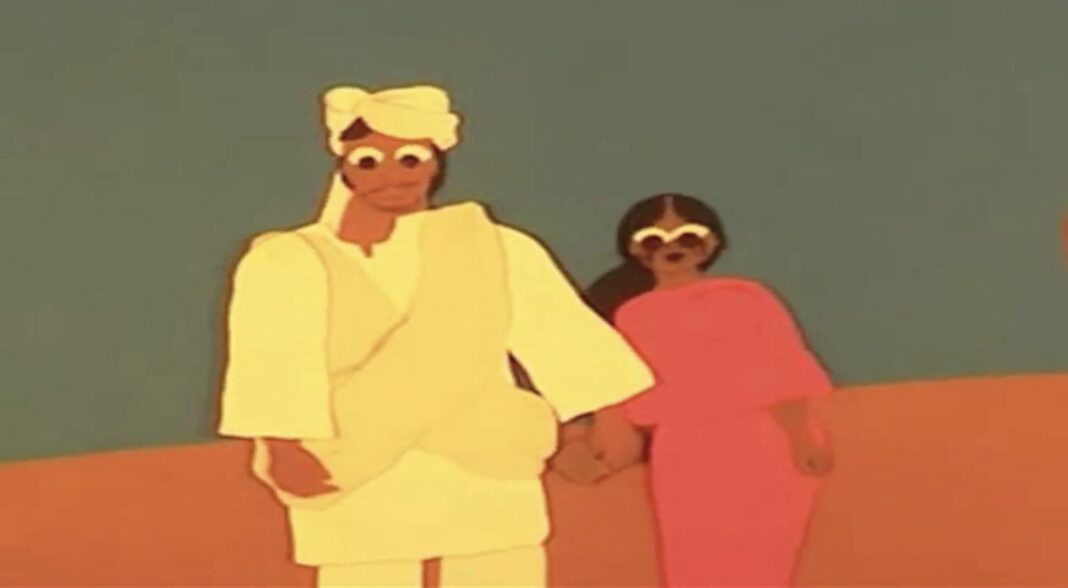
Fatima Al Samha with her husband. (Source: Mai Elgizouli YouTube channel)
In 2016, Sudanese film director Mai Elgizouli collaborated with Swedish animator Earling Ericsson to make a short film adaptation of Fatima Al Samha (Fatima, The Beautiful), another popular Sudanese folktale. Both Altayeb and Elgizouli’s versions start with a man discovering one of Fatima Al Samha’s loose hairs and swearing to marry her. Fatima flees home, goes on adventures, and then disguises herself as an old man, which leads to her finding a suitable husband.
Beyond their broad outlines, though, the stories diverge significantly. In Altayeb’s version, Fatima’s hair is found by her brother, so she leaves to escape a future of normalised incest. She embarks on various misadventures, until she encounters an old man, who she kills for his skin. Wearing it as a disguise, she continues until she is found by Sudanese folktale hero Wad an-Nimeyr. Sure of Fatima’s true identity, he challenges her to a game where the winner gets to skin the loser. Wad an-Nimeyr wins, tears her disguise, discovers her beauty, and marries her.
Elgizouli’s version eschews the incest and the flaying of senior citizens. Instead, Fatima escapes the village because Wad an-Nimeyr – who discovers the hair in this version – only values her beauty. Fatima disguises herself as an old man by making a beard out of her hair, innocent of the violence attributed to Fatima by Altayeb. She is discovered by a passerby who helps her return to her village, upon which her identity is revealed and she marries him for valuing humanity over appearances.
The two versions feature starkly different ideals of love. In Elgizouli’s version, Fatima protests against marriage rooted in physical attraction. In Altayeb’s story, however, aesthetic attraction isn’t the problem. He treats Wad an-Nimeyr marrying Fatima for her beauty as a happy ending.
By contrast, Elgizouli’s version expresses a romantic ideal of love found throughout global cinema, most famously in Disney cartoons: ‘it’s what’s on the inside that counts.’ Elgizouli’s Fatima picks her husband based on his understanding of this.
Altayeb’s story is also morally grey, in contrast to Elgizouli’s morally perfect depiction. In both stories, Fatima is defined by her craftiness, but in Altayeb’s telling, this craftiness also results in the violent death of an old man and three slaves. For Altayeb, Fatima’s ultimate marital fate is decided by a form of violence; Wad an-Nimeyr forcefully rips through her disguise. Elgizouli’s film, like Gubara’s, favors nonviolent problem solving, keeping its characters morally clean and the story easily digestible.
Fatna and the Ghoul (2025)

Waddah Eltahir’s illustration of the ‘Fatna and the Ghoul’ folktale. (Source: Folktales from Sudan YouTube channel)
In April 2025, Sudanese-American radio journalist Hana Baba, launched the Folktales from Sudan podcast, explicitly aimed for Sudanese kids and their families. While not a film, the podcast, like cinema, is a Western medium requiring pricey equipment, and thus is typically produced by urban residents. Thus, Baba’s episode ‘Fatna and the Ghoul,’ – which parallels Altayeb’s Aradeib, Saso, Nimra – shows the influence of urban tastes.
The two versions tell the story of Fatima, pronounced Fatna in Sudan, whose brother Muhammad goes out for food during the day and signals his return by singing a song. Hoping to eat Fatima, a ghoul threatens a blacksmith into modifying his voice to match Muhammad’s, so he can sing the song and enter her house. When the ghoul enters, Fatima persuades him into eating her brother instead.
From here, the stories diverge dramatically. In Baba’s telling, after Muhammad’s animal companions Aradeib, Saso, and Nimra chase the ghoul away, Fatima hugs her brother, forgiven for her betrayal under duress, and they live happily ever after.
On the other hand, in Altayeb’s version, after the animals eat the ghoul, he commands them to eat his sister alive and a passerby who witnesses Fatima’s devouring. Afterwards, Muhammad builds a tambour, a traditional Sudanese instrument, from the remains of each corpse. He then plays the three tambours, which sing songs that lay out the mistakes of the deceased individuals: jealousy, disloyalty, and nosiness respectively.
Once again, Altayeb’s retelling abounds in violent death and morally grey protagonists. The modern retelling inclines towards a happy ending, moral purity, and nonviolent resolution. Baba’s retellings are not alone in softening classic folktales. The 19th-century children’s books that formed the basis of Disney films like Frozen, Snow White, and Cinderella have also been noted for being noticeably darker than their cinematic retellings. Sanitisation of folktales, in part, may result from industry norms: ‘family-friendly’ media is made free of violence and moral ambiguity to maximise appeal. However, those very norms reflect something deeper: a change in the values, themes and moral dilemmas considered appropriate to children’s storytelling. In any society, folktales act as a snapshot of prevailing values at a particular moment. Just as Altayeb’s book captured rural northern Sudanese sentiments in the 70s, the works of Gubara, Elgizouli, Baba, and others reflect new paradigms of authentic Sudanese values among people in industrialised and globalised urban societies. Both serve as valuable insights into Sudanese thought, articulating current values in a form that links people to their elders, and, by extension, their past: the ever-enduring art of the hajwa.
500WM Columnist Hatim Eujayl is a Sudanese-American writer involved in various projects to promote Sudanese culture. His most famous works include the Sounds of Sudan YouTube channel, the Geri Fai Omir Kickstarter, and the Sawarda Nubian font. More of his writing can be found on his Substack, ‘My Sudani-American LiFE,’ where he discusses Sudanese literature and cinema. He can be reached on Instagram @massintod or by email at [email protected]
500WM Columnist Hatim Eujayl is a Sudanese-American writer involved in various projects to promote Sudanese culture. His most famous works include the Sounds of Sudan YouTube channel, the Geri Fai Omir Kickstarter, and the Sawarda Nubian font. More of his writing can be found on his Substack, ‘My Sudani-American LiFE,’ where he discusses Sudanese literature and cinema. He can be reached on Instagram @massintod or by email at [email protected].


