
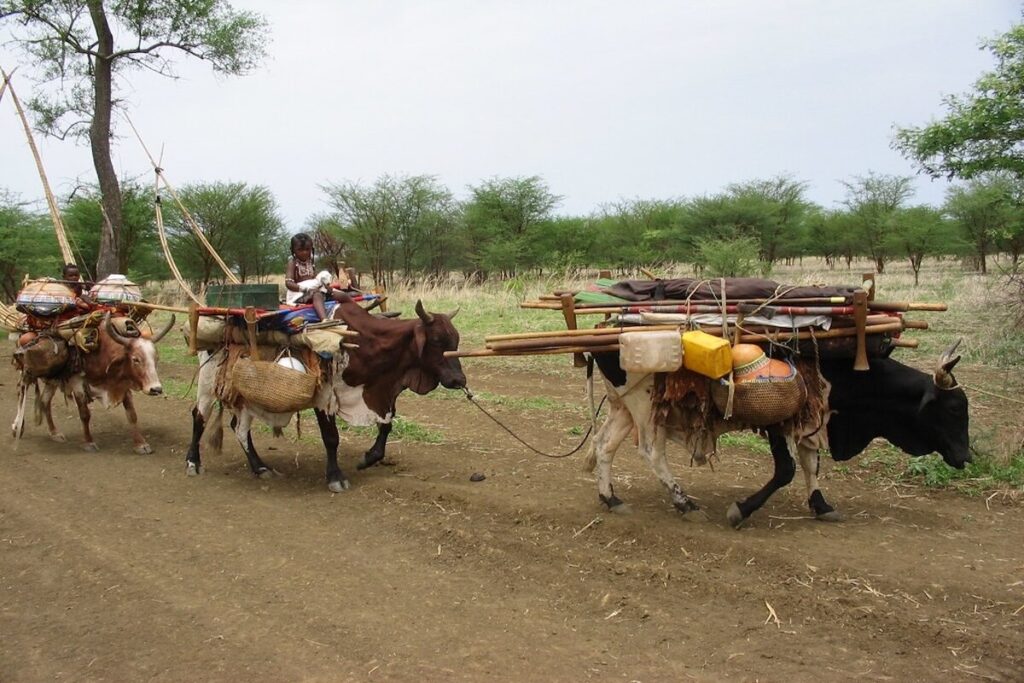
Across Sudan, pastoral households depend on their herds for both daily nourishment and economic security. Image source: H Sulieman (ILRI)
Across Sudan, dairy is not only a food group but also part of the backbone of the nation’s economy.
Livestock is the country’s largest economic subsector, larger even than petrol. Over 60% of Sudan’s agricultural value comes from animals, raised by farming and herding households in almost every state in the country. For many of these families, pastoral life and livestock are crucial to their survival, binding people to their cattle, goats, and camels in a relationship that is both practical and cultural. According to The Economics of Pastoral Livestock Production in Sudan, livestock has consistently contributed more to the national GDP than both crops and oil.
Tradition Meets Supermarket Shelves
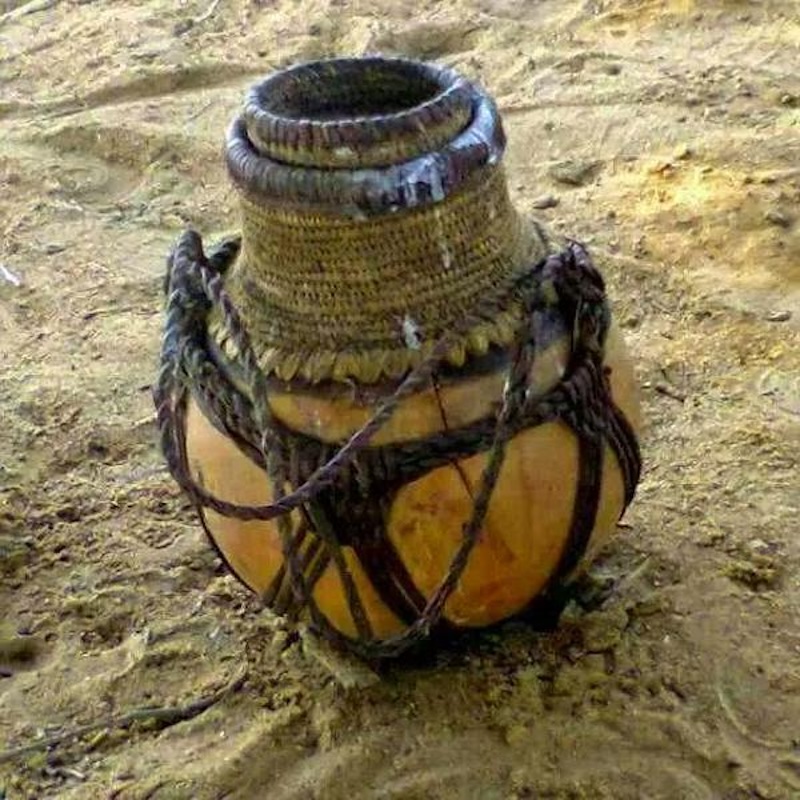
This reliance on animals naturally extends to dairy. Unlike in parts of the world where dairying has become almost entirely industrialised, Sudan’s dairy culture is a mix of two worlds. In rural areas, people stay true to handmade traditions, using simple tools and methods passed from one generation to the next. Milk is collected from the animals in the early morning, then boiled to keep it safe and processed in pots made of pumpkin, known as bukhsa in Sudan, or in goatskin bags, known as siin in Sudan. However, in more urbanised areas, dairy has taken on a more commercial face. Cartons of milk line supermarket shelves and households often buy their yoghurts and cheeses produced in modern factories. Capo of DAL Food, Sudan’s largest and most diverse food company, dominates the industry, demonstrating how corporate giants now stand alongside household traditions. However, rather than replacing one another, these two systems exist in parallel, leaving Sudan with a dairy culture that is both inherited and evolving, rooted in tradition but also adapting to the needs of modern life.
The Flavours of Khartoum’s Markets
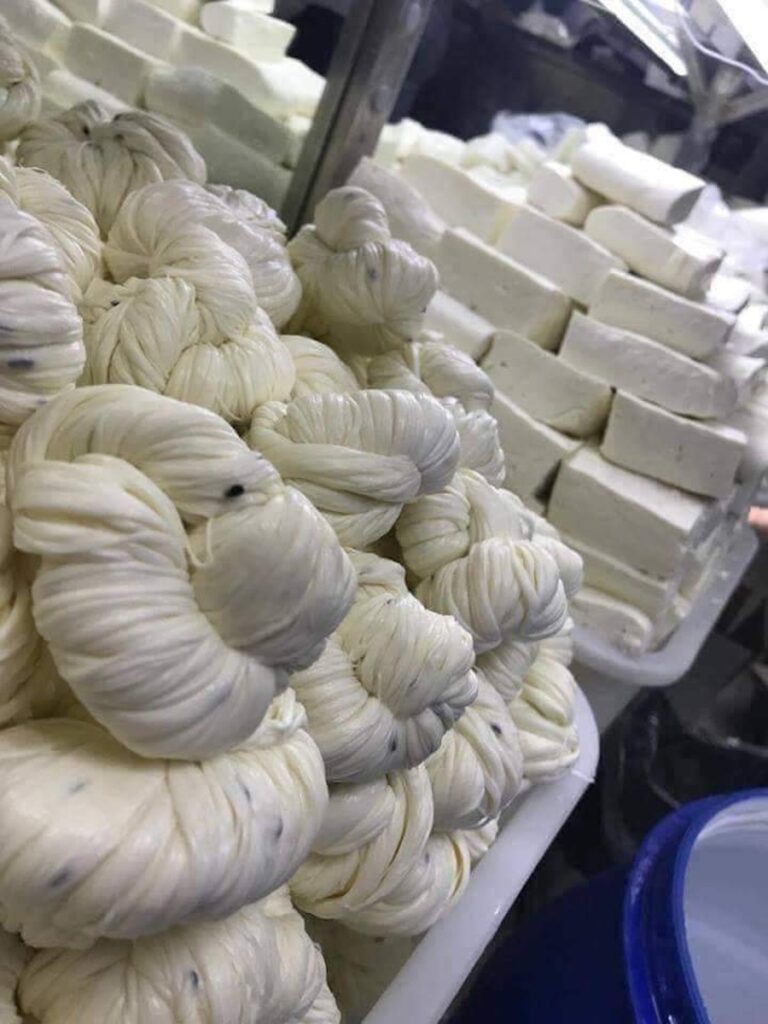
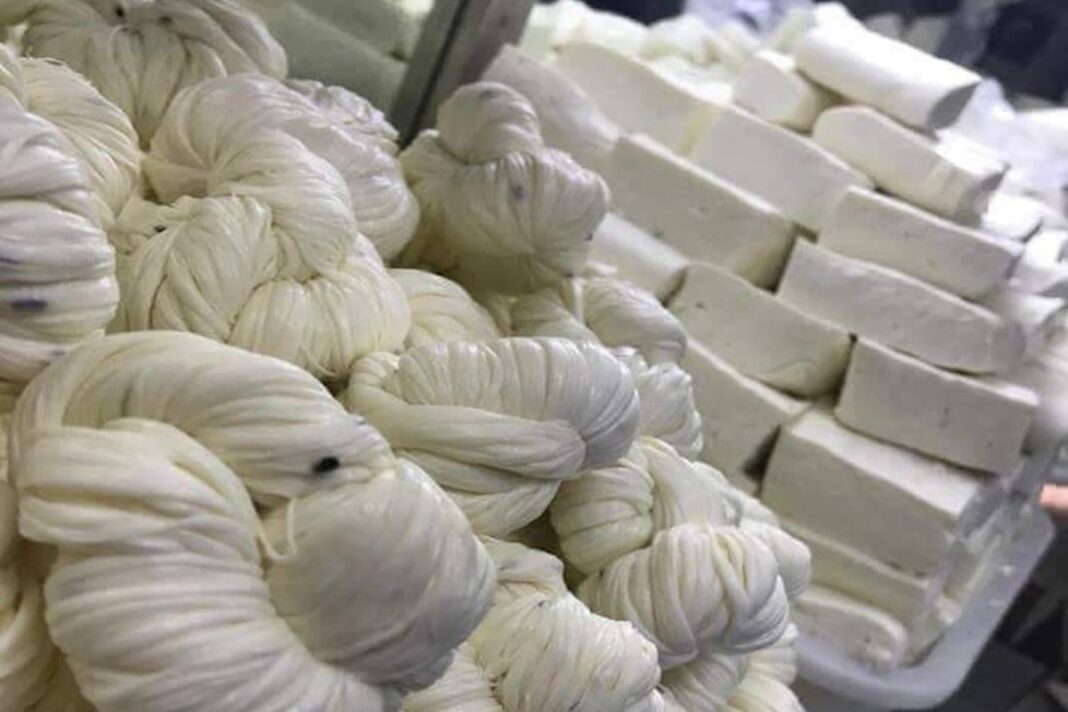
Jibna mudafara and jibna bayda sold fresh in Sudanese markets.
If you ever happen to walk through a market in Khartoum, you will see this dairy heritage on full display: brine-soaked wheels of white cheese piled high or plastic tubs of robe (sour yoghurt), still warm from fermentation. Further west, in Kordofan, jibna mudafara, which translates to braided cheese in English, is the star of the show as it fills stalls in El Obeid, the capital of the state of North Kordofan, while nomadic people relish the refreshing tang of gariss, a camel’s milk drink that carries the imprint of both desert and history. These foods are more than nourishment. They tell a story of resourcefulness and identity, one that binds families and communities as tightly as it sustains them.
Milk in Daily Life
Milk itself is the quiet companion of daily life in Sudan, most often taken as shai laban, a sweet milk tea enjoyed in the mornings and evenings. Cheese is equally central, eaten with foul at breakfast, added into a flatbread sandwich with tamiya, which is also known as falafel, or grated onto a warm lentil stew. In all of its many forms and uses, dairy is woven into the everyday rhythms of Sudanese life.
From Al Dewaim to Every Table
Cheese-making has long been a way to stretch the life of milk, a necessity in a country where pastoral life is so dominant and milk may be abundant in one season but scarce in the next. The most familiar and more commonly used type of cheese to the majority of Sudanese is jibna bayda, which translates to white cheese. It is also known as jibna al dewaim in reference to the city of its origin, Al Dewaim in the White Nile State. It is crumbly, salty, and sharp, resembling feta, but unmistakably Sudanese in its taste. Its low price also means that everyone can buy it, even poorer families, making it a true staple of everyday life.
Braided with History: From Armenia to Kordofan
Perhaps the most distinctive of all Sudanese cheeses is jibna mudafara, which carries a story of migration and adaptation. It traces back to Armenian string cheese, known as chechil, and was introduced to Sudan in the 1930s by a Greek settler named Pinioti Raptoulis in the Kazgeel district of North Kordofan. He taught local families the craft and the cheese soon became a Kordofani trademark. Traditionally prepared in small workshops, it is made by curdling milk with rennet, kneading the curds in hot water until elastic, seasoning them with black cumin, then braiding and salting the strands while still warm. Slow to spoil because it is cooked over fire, jibna mudafara remains a favourite in El Obeid’s markets. Unlike jibna bayda, it is less affordable and often bought as a treat, thanks to its time-consuming preparation, with many families buying it occasionally rather than for everyday use.
The Tang of Robe
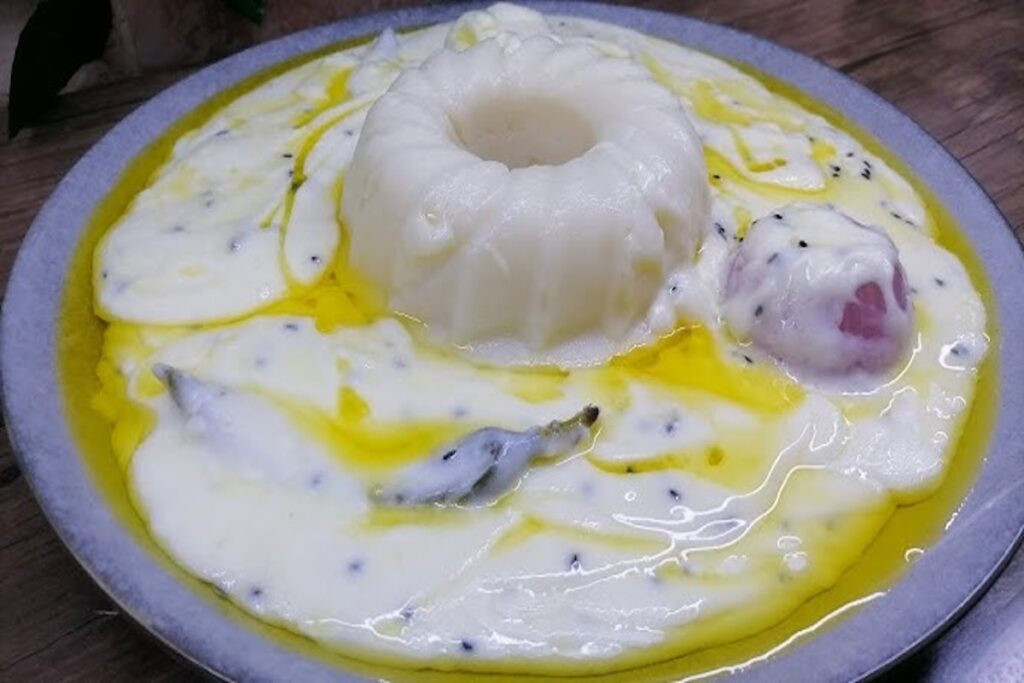
Mulah rob (sour yoghurt stew) served with samin, a classic Sudanese dish that brings together two staples of the country’s dairy tradition: fermented rob and clarified butter.
Whilst cheese preserves milk in its solid form, fermentation offers the greatest variety of dairy foods. The most common example of this is robe, which is made by leaving milk to sour overnight before churning it into butter. What remains is a tangy buttermilk, a staple in many households and the base of mulah robe, one of the most popular Sudanese stews. To make it, robe is cooked with onions and spices, sometimes with dried meat or ground okra, then eaten with kisra or asida. Mulah robe is especially popular during the holy month of Ramadan, when it appears on almost every table as part of the evening meal. Production of rob peaks during the rainy season, when herds produce milk in abundance. Yoghurt is also added to other everyday traditional dishes such as mulah neiamea.
Liquid Gold
Sudanese ghee, known as samin, is one of the most treasured products of this cycle. Made by boiling butter until it separates into a clear, golden fat, it can be stored for long periods and is used both as a cooking fat and a flavouring. A spoonful stirred into a stew can transform a simple meal into something more hearty and festive, and its presence at the table is considered a sign of generosity. Samin is more on the costly side, since a large amount of butter is needed to make even a small jar, and so it is often reserved for special recipes rather than for everyday cooking.
The Sweet Side of Sudanese Dairy

Kunafa stuffed with gishta, a favourite pastry across Sudan and the region.
Gishta is a thick cream made from skimming the top layer of boiled milk, beloved in Sudan for its rich taste and creamy texture. Because it takes a lot of milk to make only a little cream, gishta is much more expensive than other dairy foods and is often reserved for guests or festive occasions. It is eaten fresh, spread on bread with honey, and also used as a filling for desserts such as kunafa. Loved as both a luxury and a comfort, gishta remains one of Sudan’s favourite dairy delights.
A Shared Taste with Neighbouring Egypt
A more unusual dairy is mish, a sharp, pungent cheese that is very strongly fermented which recalls Sudan’s culinary ties with Egypt, where mish has long been a part of the Egyptian diet. More recently, urban communities have embraced Egyptian-style white cheese, yoghurt, and black cumin-flavoured mish, serving as reminders that Sudanese dairy, just as in the example of jibna mudafara, has always absorbed outside influences while keeping its own identity intact.
Gariss: Camel Milk on the Move
For the nomadic communities of Kordofan, Darfur, and the Red Sea region, the camel is not only a method of transport but a source of life, producing milk in landscapes where little else endures. Fresh camel milk is beloved for its sweetness and is believed to soothe stomach ailments, strengthen the body, and cool off the heat of the desert. Most distinctive of all is gariss, a fermented camel’s milk drink traditionally prepared in a siin. The milk ferments as it is carried on camelback, taking on a tangy, smoky flavour. For the herders who rely on it during long journeys, gariss is more than a refreshing drink; it is identity and a taste that connects them to centuries of pastoral tradition.
Women’s Quiet Craft
In Sudan, dairy is more than just food. A warm cup of shai laban in the evening or a jar of jibna bayda in the fridge speaks as much about family and cultural history as it does about appetite. Perhaps most importantly, dairy traditions live in the hands of women. It is women who ferment the milk, churn the butter, and salt the cheese, passing down skills as part of daily life rather than formal instruction. Repeated quietly across generations, these acts preserve a hidden culture of resilience and adaptation.
From Sudan to the World

Sudan’s CAPO brand was available in stores in Qatar.
Photo credit: X (formerly Twitter @kanowri82)
In some countries, especially in the Middle East and North Africa (MENA) region where the Sudanese diaspora is largest, Sudanese cheese such as jibna mudafara and jibna bayda are available for purchase at Sudanese shops and restaurants, giving families abroad the chance to keep familiar flavours on their tables and share a taste of home with the younger generations. In recent years, Sudanese brands such as DAL Food’s Capo, and other Sudanese cheese and other dairy products have reached supermarket shelves in places such as Egypt, Qatar, the UAE and Saudi Arabia, a sign of Sudan’s dairy industry breaking through and finding success beyond its borders.
More than Milk
Sudanese dairy is not a story of mass production or export but one that is built on clay pots, goatskin bags, and family kitchens. To taste it is to experience generosity as much as survival and with every spoonful of robe or sip of gariss lies the reminder that food is not only nourishment, it is also memory, identity, and endurance. Sudanese dairy may not always come in the most glossy packaging, but its richness lies in something far more enduring: the culture that keeps it alive.
Khansa Al Bashier is a 25-year-old medical school graduate exploring her passion for writing and storytelling, with a deep interest in Sudanese culture, history, and politics.

Khansa Al Bashier is a medical school graduate exploring her passion for writing and storytelling, with a deep interest in Sudanese culture, history, and politics.