
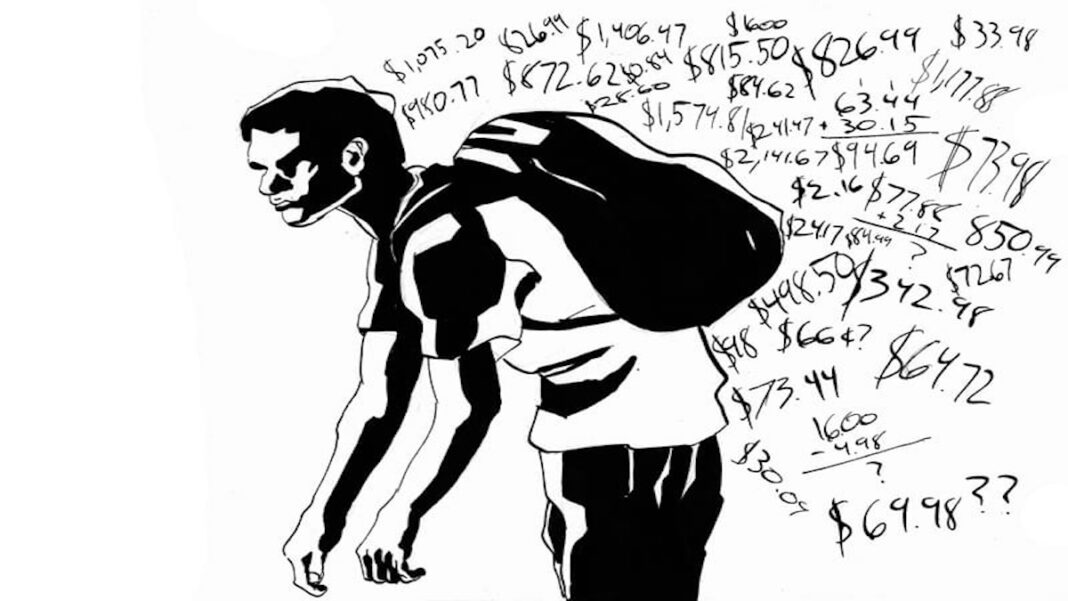
How misunderstanding economics shaped public perception before and during Sudan’s war, turning confusion into conflict and propaganda into power.
In Sudan’s history of conflicts, some of the most powerful weapons were not carried. They were spoken.
They appear in the explanations people give for empty shelves, rising prices, and closed banks. In a country where daily survival depends on understanding why things disappear, belief has often replaced understanding. The result is a war fought not only on the ground, but in conversations where certainty spreads faster than truth.
Before the War Had a Name
At a small market in Omdurman, I saw a shopkeeper who had stopped writing prices on his shelves. A situation frequently observed by local residents during the era of rapid price changes, he laughed when I asked why, “It is pointless,” he said. “By the time the ink dries, the number would already be wrong.”
This pattern of belief did not begin with the war. For years, Sudanese people lived through subsidy removals, currency devaluations, and rising debt while economic concepts remained distant and abstract. When the Sudanese pound fell, food prices rose. When fuel became scarce, transport and electricity followed. These were systemic failures but they were experienced as intentional acts by someone, somewhere. Customers no longer asked how much things cost. They asked who was responsible. Most of the blame falls on the two warring forces currently leading the war in Sudan. Some blame the Sudanese Armed Forces (SAF). Some blame the Rapid Support Forces (RSF). Others blame politicians, including civilian-led political groups, who had been arguing for years about leading Sudan into democracy. The shopkeeper did not argue back. He only pointed to an empty sugar sack behind him.
What began as a question about bread became a political argument. The shelves were the same for everyone. The explanations were not. Few people mentioned inflation, disrupted supply chains, fuel shortages, or blocked roads. The economic chain was invisible and people saw instead was betrayal.
April 2023: Propaganda, Loyalty, and the Economy of Blame
For those who continued to live in Sudan or returned during the war, daily life quickly became unaffordable, from rent and transportation to basic groceries.
When fighting erupted in April 2023 between the SAF and the RSF, confusion turned into catastrophe. Roads closed. Banks shut down. Markets collapsed. Salaries stopped. Cash lost meaning. According to The World Bank Group (WBG) estimates, Sudan’s inflation surged above 200%, while the currency lost much of its value in a matter of months. Food prices in some areas rose by more than 300 %, and over 25 million people – more than half the nation’s population – now face acute food insecurity. Yet for many families, these figures were not understood as economic collapse. They were understood as intentional harm.
Into this uncertainty came propaganda.
Voice messages, short videos, and social media posts offered simple explanations: one side was starving civilians, another was stealing resources, another was sabotaging the country for political survival. These narratives spread not because they were proven, but because they were emotionally reassuring. In moments of fear, the most comforting explanation often replaces the most accurate one.
Supporters of the SAF, RSF, and political forces such as the Forces of Freedom and Change (FFC) increasingly interpreted economic suffering through loyalty. Supporting a side began to mean dismissing the suffering caused by that side. And in the absence of basic economic literacy, people were left to evaluate information emotionally rather than analytically, and what felt true mattered more than what could be explained. Currency collapse, food shortages, and blocked aid routes stopped being shared consequences of war and became evidence of moral wrongdoing by rivals.
The Social Cost of Not Knowing
The consequences of the lack of basic economic literacy were visible everywhere. Online spaces turned hostile. Families avoided political conversations. Friends accused one another of betrayal based on which explanation they believed. Economic hardship became political evidence. Hunger became an accusation. Shortages became loyalty tests. This division did not only fracture politics it fractured society. The economy, instead of being recognised as a system collapsing under war, became a weapon used to justify hatred and suspicion.
None of this suggests that ordinary Sudanese people are to blame. War overwhelms judgment, and survival leaves little space for analysis. But it reveals how dangerous it is to navigate crisis without the tools to understand it. Economic literacy does not eliminate propaganda, but it weakens it.
Economic literacy in a war zone is not about mastery or certainty. It is about recognising patterns before assigning blame. About noticing that shortages follow closed roads, that prices rise when fuel disappears, and that banks do not function in active conflict. These are not political choices as much as they are consequences.
Economic literacy is simply understanding how money works in the world, and how money or the economy affects your life. As American economist Gary H Stern put it, “Economic literacy is crucial because it is a measure of whether people understand the forces that significantly affect the quality of their life.” It’s closely tied to financial literacy, and understanding and teaching finical illtercay, spending, saving and budgeting, lifelong skills, entrepreneurship, and much more.
Today, Sudan faces one of the worst humanitarian crises in the world. Alongside physical destruction lies quieter damage: a society trained to interpret suffering through belief rather than understanding. If this does not change, the war will outlive the fighting. The real danger is not only weapons. It is what happens when people do not understand the forces shaping their lives and someone else steps in to explain them instead.

Raghad GA Adam is a senior high school student, artist, debater. She spends her days sketching, writing, and reading everything she can get her hands on. An active participant in Model United Nations (MUN) conferences, as she loves debating big ideas as much as she loves turning her thoughts into art.