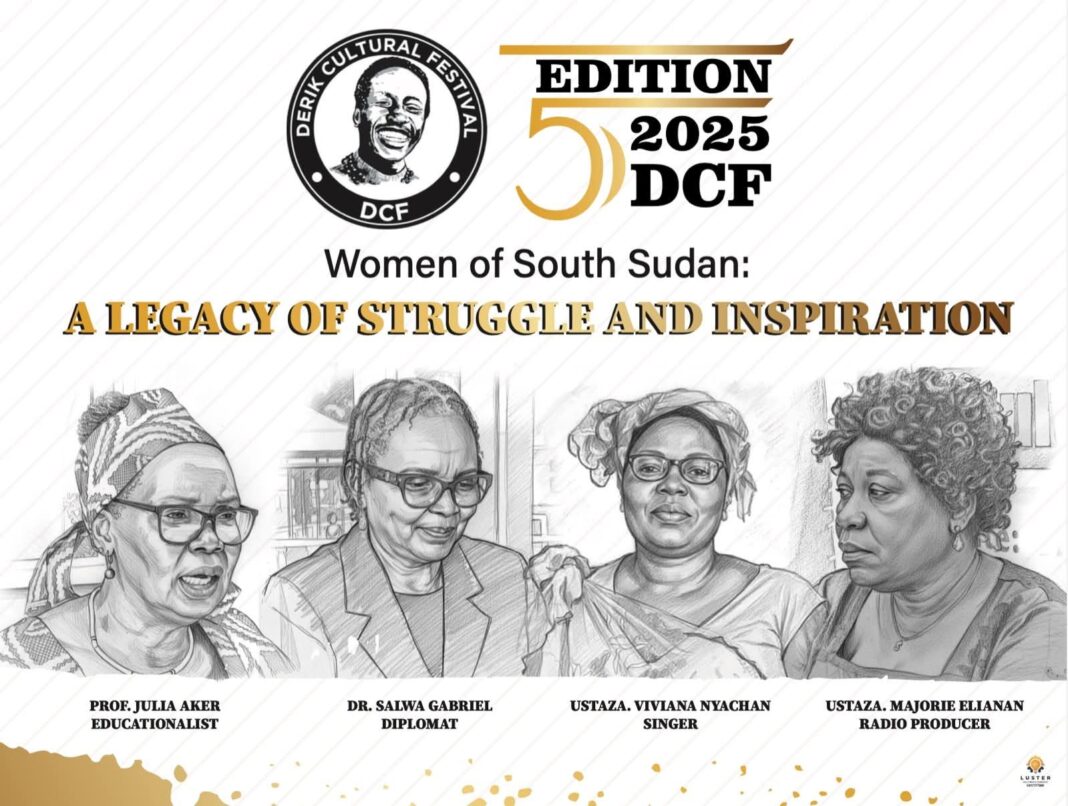

As the curtains went down on Sunday, 24 November 2025 on the 5th edition of Derik Cultural Festival (DCF) at the University of Juba, the air was left thick not just with sounds of traditional music and rhythms, but with a profound sense of introspection.
In this year’s edition, which opened on 15 November, and for the first time since the inception of DCF in 2021, South Sudan’s premier platform for intellectual and artistic dialogue. Established to foster national identity and heal the wounds of civil war through culture, it has become a vital institution for archiving our history. The organising committee chose four phenomenal women to celebrate under the theme, “Women of South Sudan: A Legacy of Struggle and Inspiration,” emphasising that women are not just the carrier of culture, rather they are the backbone of our nation.
The DCF is named after the late South Sudanese cultural icon Derik Uya Alfred (1962–2021), a man who dedicated his life for culture and viewed it as the software of nation-building. A cultural icon and playwright, he also served as the former state Minister of Culture in Western Bahr El Ghazal. He is best remembered as the founder of the Kwoto Cultural Center, where he used theater and dance to bridge the divide between North and South Sudan during the years of conflict between the two regions, before South Sudan’s secession in 2011. Yet, this edition felt different. It was not merely a display of heritage, it was a correction of history, listening to women’s narrative about the liberation movement, and their concern on contemporary issues, and thoughts for the future of the nation.
Moving around the festival grounds, one could feel the spirit of Uya. He had always envisioned arts as a bridging tool, and this year, the bridge was built towards the often-unsung heroines of our history. However, the decision of honouring trailblazers such as educationalist Professor Julia Aker, pioneering diplomat Salwa Gabriel, music icon Viviana Nyacha, and drama and broadcasting pioneer Majorie Elianan, were masterstrokes.
In the dialogue session held with the distinguished women, the thing that stuck with me the most was Aker’s narrative about her childhood education and how the war affected cultural life when she said, “When the war broke out, all the intellectuals fled the town, including my father.” That is a phrase that has always been absent from stories from the days of the first civil war, and which brings back the moral losses of the war, including the culture and what it brought to societies. In a country where political narratives often dominate the headlines, dedicating a week to the cultural and intellectual contributions of women is a radical act. It shifts the gaze from the men who fight wars to the women who sustain life and society amidst the chaos.
In the same orbit in which the dialogue took place, Elianan addressed the rising generation of women with the words of her late father: “My daughters, your husband will be the pen because no man will support you except your pen.” This was their greatest commandment at home. Even when they were forced to study Islamic education at school, they held on to the pen as a tax to continue the journey. It is worth noting that her journey was crowned with great success, as she became the first woman from South Sudan to graduate from the Higher Institute of Arts and Theater in 1983, and after another three years, she graduated from Cairo University in Khartoum, currently known as Nilein University, with a bachelor’s degree in philosophy.
The strange link between Elianan and the character of the late Uya is their awareness of the importance of culture and cultural exchange in supporting social harmony. During her work at the Radio and Television Corporation, she personally supervised the directing of the programmes Babour Mashi and Al Turath magazine, which aimed to introduce the southern part of the country at that time. Southern heritage and culture were absent from the northern side of the country, and I consider Al Turath magazine one of the achievements that I am most proud of The people of the North had no knowledge of the South, starting with the traditions of weddings, celebrations, and funerals, as well as ignorance of the names of its cities, cultures, heritage, and even its popular stories.
In the midst of celebrating past achievements, there was space to discuss current issues. Especially those that directly affect women. On the seventh day of the festival, economist Elizabeth Achou gave a presentation on economic empowerment and “quota system,” which was another wake-up call. However, in her presentation she made a comparison between South Sudan and Rwanda that was stinging but necessary. The conclusion of her presentation was oriented to more positive actions to give meaning to the 35% political quota of women to back up the economy.
Five years on, the DCF has proven it is not a fleeting event. However, an institution that carries Uya’s vision forward facing what remains from challenges in the path. However, as the festival concluded, it left us with questions of how do we take the energy from the University of Juba and translate it into a policy for a better change? How do we ensure that women honoured are not just celebrated in speeches but emulated in our schools and government offices?
If the late Uya were here today, he would likely smile, not because the work is done, but because we have finally started singing the right song.

Butros Nicola Bazia, born in Khartoum, Sudan in 2001, is a South Sudanese freelance writer, storyteller, and cultural commentator based in Juba, South Sudan. Nicola serves as columnist at 500 Words Magazine and contributed to multilingual regional and international platforms including The New Humanitarian, Mundo Negro, El Pais, Contemporary&, The Van-Magazine, and among others. His work explores the intersections of arts and socio-cultural dynamics, with a focus on South Sudanese narratives in the global conversations.