
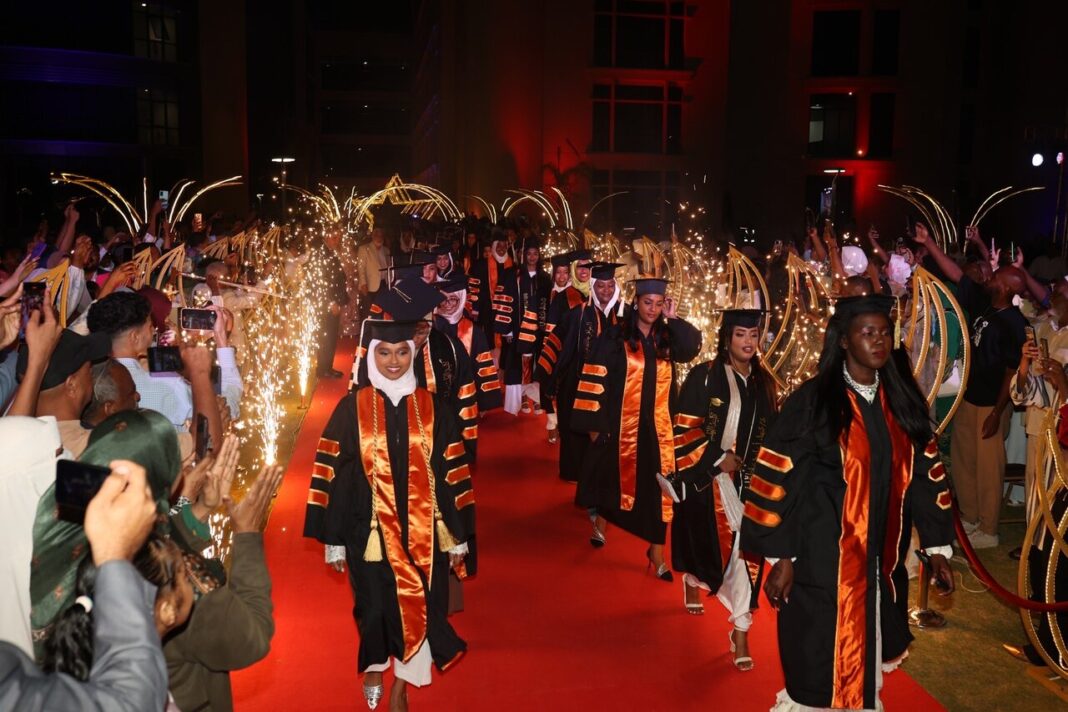

As the sun set over the Egyptian city of El-Alamein on the evening of 16 June 2025, 160 young women stood in their graduation gowns, dignified and full of hope for the future. Though a thousand miles, and a world of upheaval, separated them from their alma mater, Ahfad University for Women (AUW) in Sudan, they carried its spirit with them as they crossed the stage not only as graduates but for many of them, as survivors.
This moment was more than just a celebration of academic achievement for the medical school finalists, but a testament to the power of education, the strength of solidarity between neighbours, and the unwavering determination of those who refuse to let war define their future.
In April 2023, war erupted in Sudan between the Sudanese Armed Forces (SAF) and the paramilitary Rapid Support Forces (RSF) and lives were shattered overnight. Due to the war, over 12 million people have been displaced with over 4 million fleeing to neighbouring countries, creating the world’s worst displacement crisis. According to UNHCR (June 2025), Egypt has received around 1.5 million Sudanese refugees, followed by South Sudan with 1.1 million, Chad with 850,000, and Ethiopia with 500,000. Inside Sudan, over 9 million people remain internally displaced due to the ongoing violence .
For these young women, the war meant the collapse of everything they knew and all that was once familiar. The streets they had walked through became riddled with bullet holes, the hospitals they had trained in were transformed into war zones overnight and their entire lives were hastily packed into bags, as home became a memory too dangerous to return to.
Many of them were either internally displaced or became refugees, scattered across borders, carrying with them the scars of loss, fear, and grief over their unfulfilled dreams. For over a year, there seemed to be no path forward, just silence, waiting, and survival – the future they had worked towards seemed to have crumbled under the weight of war.
Yet amid the devastation, a lifeline emerged through the collaboration between Sudan’s AUW and Egypt’s Arab Academy for Science, Technology and Maritime Transport, which allowed them to complete their education in Egypt. These students were given much more than just classrooms; they were given a chance to reclaim their futures. What began in crisis became a testament to resilience, solidarity, and the unbreakable spirit of young women who refused to let their futures be buried under the rubble.

The momentous ceremony was attended by many of the graduates’ families, faculty members, and administrative staff from both institutions and countries. The ceremony was also attended by officials and dignitaries. Representing the transitional sovereignty council of Sudan was Lieutenant General Yasser Mohamed Othman, who is also director general of the administration of border crossings and ports. Governor of Matrouh Major General Khaled Shuaib, and Ambassador of the Republic of Sudan to Egypt and permanent representative to the Arab League, His Excellency Emad Al Din Mustafa Adawi, were also in attendance.
During the ceremony, President of the Arab Academy for Science, Technology and Maritime Transport, Professor Ismail Abdel Ghaffar Ismail Farag, and President of Ahfad University for Women, Professor Gasim Badri, exchanged words of solidarity, highlighting the deep ties between Sudan and Egypt. Their remarks reflected not only a shared academic mission but also a profound sense of regional unity in the face of crisis, emphasising education as a bridge between nations in times of need.
The speech

In a moving speech during the graduation ceremony, 25-year-old graduate Alaa Mutaz Abdelbagi addressed the audience, saying, ‘Allow me to honour where I come from: my beloved country, Sudan – the land of golden sunsets and ancient rivers; a country with a soul that stretches from the heart of Africa to the shores of the Red Sea. It is the beat and rhythm in our hearts, the warmth and affection in our families that have kept us going, and the streets that moulded us into the people we are today. It is the place that shaped our souls long before we had the words to describe who we were.’
‘But today, I speak of Sudan with both love and sorrow. We all carry wounds – some visible, but many silent – for we were not just displaced; we were uprooted. Yet despite the loss, we are still standing. We carry our country within us – in our resilience and in our determination to rebuild. Wherever we may be, and no matter where life takes us, we will rise again – not in spite of our pain, but because of it. We were forced to abandon our homes on random days, leaving behind memories, carrying uncertainty in our hands and grief in our hearts.’
‘We were strangers stepping into a land that was not our own. But Egypt, in all its history and humanity, opened its arms to us. Our Egyptian sisters and brothers saw our pain and met it with compassion. They treated us not as a burden, but as siblings – reminding us that we were not alone. I say this from the deepest part of my heart: thank you.’
She went on to thank the host university on behalf of her classmates, saying, ‘To the Arab Academy for Science and Technology, College of Medicine, we cannot express enough our sincere appreciation to every single person working at this prestigious institute for embracing us and giving us the chance to continue our studies after they were paused for over a year. This university hosted us during the darkest time of our journey. You looked at us as students, worthy of opportunity. Thank you for giving us a place to try and to succeed.’
Ahfad University for Women (AUW)

In an interview with Egyptian Channel 1, Professor Gasim Badri spoke briefly about the history of AUW, an institution renowned for empowering women through education, with a strong commitment to leadership, community service and social development. Providing insight into the university’s plans for the future, he said, ‘Ahfad University for Women has a plan for development in place when we return to Sudan’, offering a vision of hope in which future graduation ceremonies for generations to come will once again be held at home.

Located in Omdurman, AUW is a pioneering private institution founded in 1966 by Yusuf Badri, continuing a legacy of women’s education begun by his father, Babiker Badri, a reformer credited with revolutionising women’s education in Sudan. As the first higher education institution for women in Sudan, AUW traces its roots to 1907 when Babiker Badri established the country’s first school for girls, defying the social norms of the time. What began with just 23 students and three faculty members has grown into a thriving university enrolling between 6,000 and 8,000 students across eight schools, offering programmes from undergraduate to PhD level. AUW remains female-only to preserve its founding mission and provide a supportive environment where women can access quality education, develop leadership skills, and become active agents of change. Under the leadership of Professor Gasim Badri, AUW stands as a beacon of academic excellence and social progress in Sudan and beyond.
Continuing education after war
The ongoing war in Sudan has devastated the country’s educational infrastructure, leaving schools, universities, and other institutions in ruins and forcing 19 million children out of school. Since April 2023, the vast majority of Sudanese children have missed nearly two full academic years due to widespread school closures. For displaced students within Sudan, some schools and universities have temporarily relocated to Port Sudan or transitioned online to keep education going.
On 3 July 2025, after two years of conflict and multiple delays, approximately 210,000 students registered to sit for exams at nearly 2,000 centres across the country, including in Khartoum, Al-Gezira, Sennar, and Port Sudan, as well as at 50 centres in neighbouring countries such as Chad and Egypt, where many Sudanese refugees are currently hosted.
Sudanese children displaced outside the country are also struggling to access education; however, some Sudanese schools have been reestablished in Egypt. In addition, pre-existing Sudanese schools in the diaspora have been able to accommodate some of the displaced students.
In regards to students pursuing higher education, like AUW, many other Sudanese higher education institutions that have turned to international partnerships to keep education going in the wake of the war. Universities such as the University of Khartoum, the University of Science and Technology, and the University of Medical Sciences and Technology have established alternative campuses or collaborative programmes in countries including Egypt, Saudi Arabia, Rwanda, and Tanzania allowing their displaced students to continue their studies despite the crisis at home.
Khansa Al Bashier is a 25-year-old medical school graduate exploring her passion for writing and storytelling, with a deep interest in Sudanese culture, history, and politics.

Khansa Al Bashier is a medical school graduate exploring her passion for writing and storytelling, with a deep interest in Sudanese culture, history, and politics.