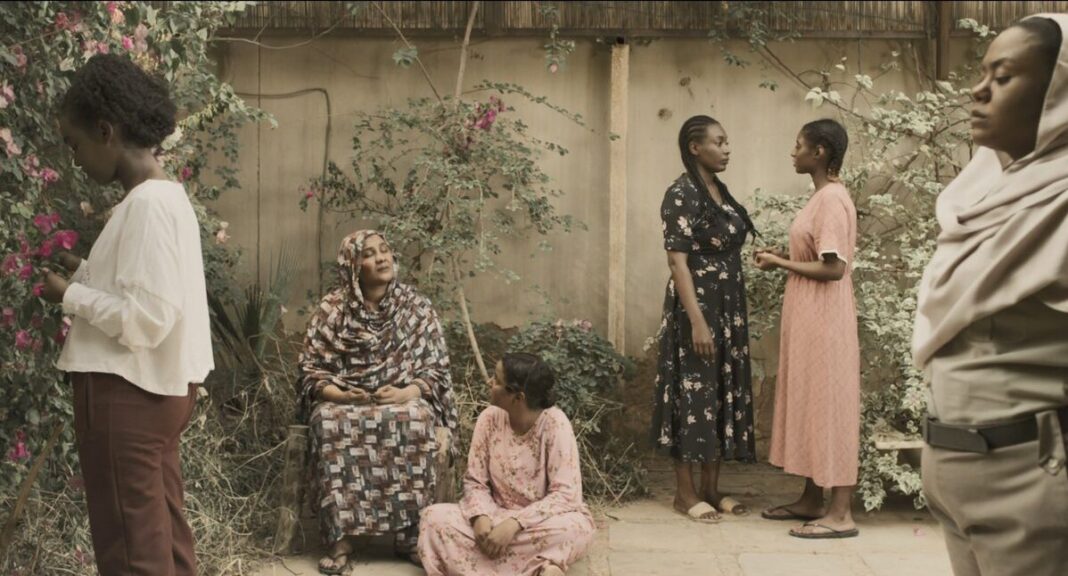
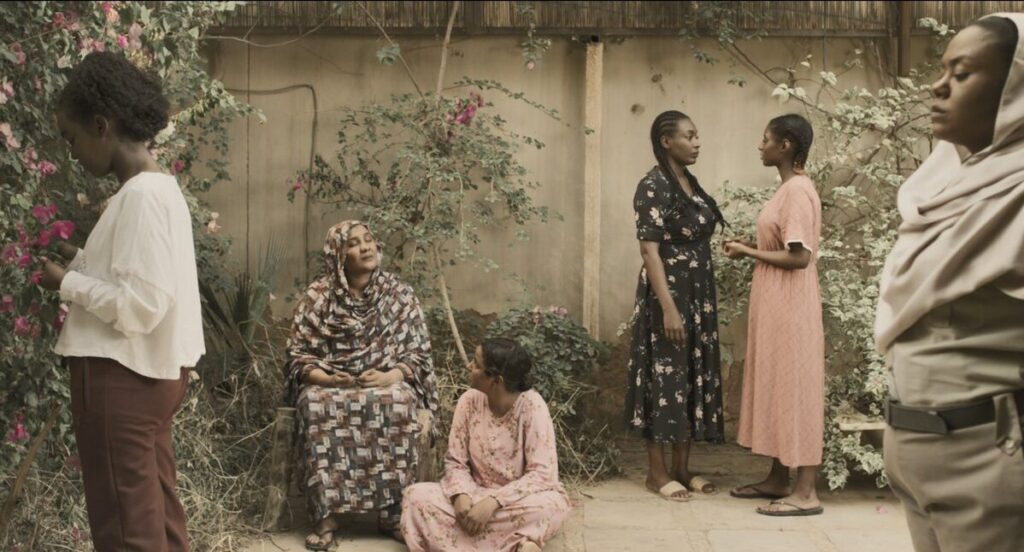
A shot of a scene with the cast of six women in Bougainvillea, including Linda Omer, Islam Mubarak, Shuhanda Abubakr, Shams Mubarak, and Mona Osama. Source: Locarno Film Festival
The 2018 December Revolution was a moment of political awakening for Sudanese locally and globally, impacting every level of society, including the burgeoning film industry.
The past six years have seen a flurry of directors tackling its complex legacy, particularly in light of the current civil war, whose immense humanitarian tragedy contrasts starkly with the optimism embodied by the 2018 uprising.
It is in this context that Sudanese director Yasir Faiz’s short film, Bougainvillea (Arabic: Jahannamiyya), emerges. Positioned as a ‘tribute to the resilient women of Sudan,’ the film centres on the experiences of a group of women incarcerated for protesting the regime. It offers a creative and sympathetic portrayal of female revolutionaries, while growing the medium by bringing a wealth of new faces and ideas to the screen. The well-intentioned short film’s emotional impact, however, is limited by some shortcomings in its script and performances.
The Filmmaker
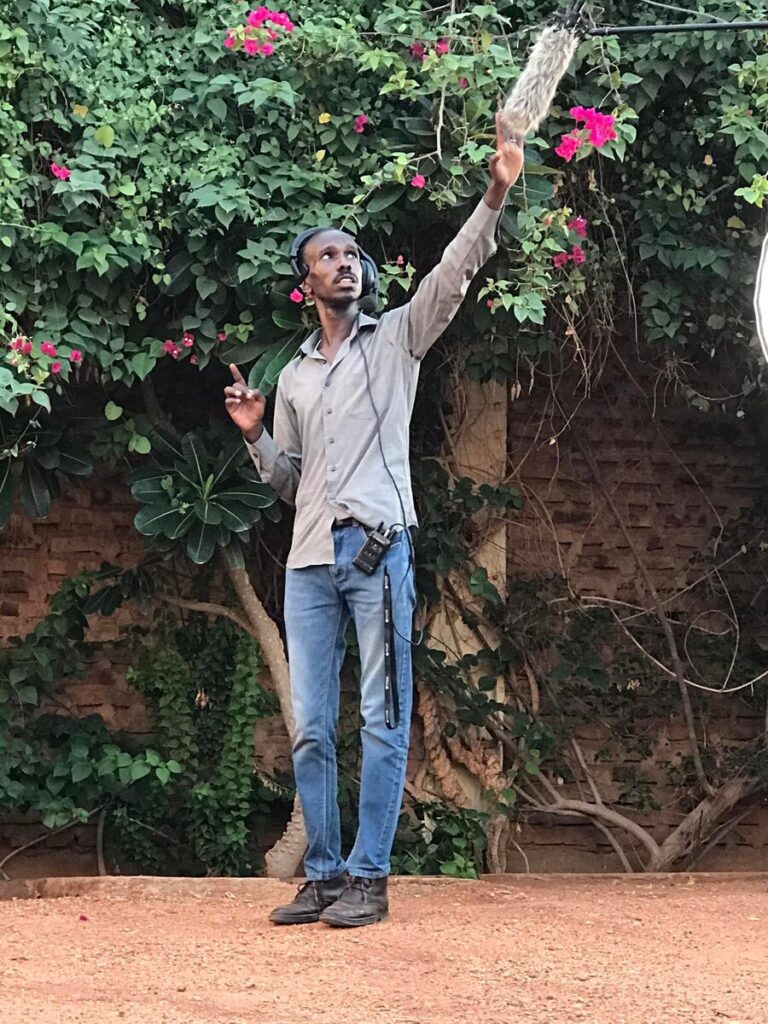
Filmmaker Yasir Faiz surrounded by bougainvilleas during the production of Bougainvillea.
Image courtesy: Yasir Faiz
Sudanese filmmaker and journalist Yasir Faiz was raised in Iraq, moving back to Sudan at the age of 20. He began filmmaking as a hobby in 2003 to connect with the Sudanese identity he felt alienated from due to his upbringing abroad. In 2011, after a call for new filmmakers by the Goethe-Institut in Sudan, a German non-profit learning centre, Faiz began his professional filmmaking career in earnest with an experimental short film.
Sudan’s changing political landscape, however, would soon come to play a crucial role in shaping his filmmaking. In 2013, anti-regime civilian protests led to Faiz’s disillusionment with the Sudanese media, which he described as “fail[ing] to cover what was happening on the ground.” He resigned from his position as a journalist, and founded the production company In Deep Visions, which would launch an initiative that trained 300 Sudanese kids in filmmaking, producing over 70 short films. Faiz described himself as wanting to “build a generation that could see film not just for entertainment, but as a tool for expression.”
This emphasis on cinema as a means of telling truths obscured by the press engendered an artistic philosophy that prioritises realism. In an interview with the Kenya-based Sudanese artists collective, The Rest Residency, Faiz emphasised his desire to portray ‘reality’ and offer “a creative testament to the experiences of the generation and myself.”
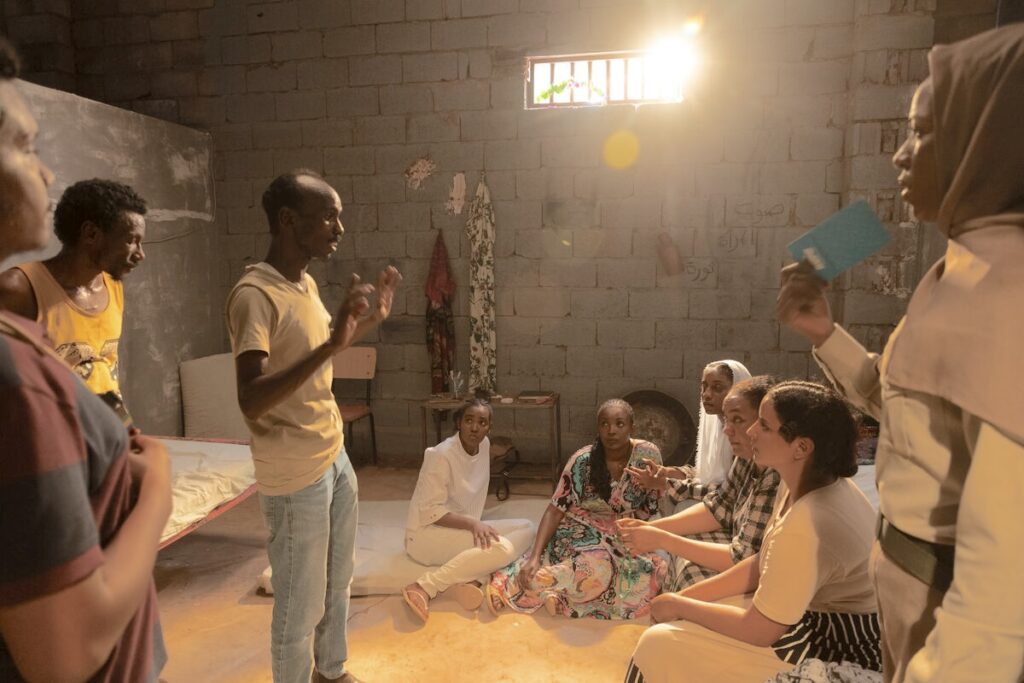
Yasir Faiz directs the cast of Bougainvillea, with co-producer Ibrahim “Snoopy” Ahmed behind him. Image courtesy: Yasir Faiz
Faiz eventually moved from grassroots filmmaking initiatives to co-producing short films for a festival audience, including award-winning short documentary Journey to Kenya (2020), a film about a Sudanese Jiujitsu team with no funds competing in a tournament in Nairobi. During this film, Faiz worked with Bougainvillea’s future co-producer, Ibrahim “Snoopy” Ahmed, a Sudanese filmmaker now known for his involvement in the acclaimed films Khartoum (2025) and Serotonin (2018).
It wasn’t until 2021 that he would cinematically synthesise his journalism with his support for Sudan’s civilian uprisings, as a series of interviews with female detainees inspired Faiz to write the screenplay that would become his solo directorial debut: Bougainvillea.
Like many Sudanese directors, Faiz’s filmmaking process was inhibited by financial limitations and government restrictions. As the Sudanese film industry is still nascent, Faiz was required to personally finance much of the film’s production, costs that skyrocketed due to two political crises. First, the 2021 coup by army general Abdel Fattah Al Burhan, which revoked the filmmakers’ permission to film in a prison, required the construction of a set outside the bounds of government surveillance. Secondly, the 2023 insurgency by the Rapid Support Forces (RSF) and ensuing civil war led to: the destruction of Faiz’s office; the arrest of a man on the way to receive Bougainvillea’s edited footage from said office; and the displacement of the director himself.
Despite Faiz’s passion for making films in Sudan to build a local industry, circumstances required his film be completed in Egypt, where he’d taken refuge before finally settling in Kenya.
The Film: Distribution and Cast
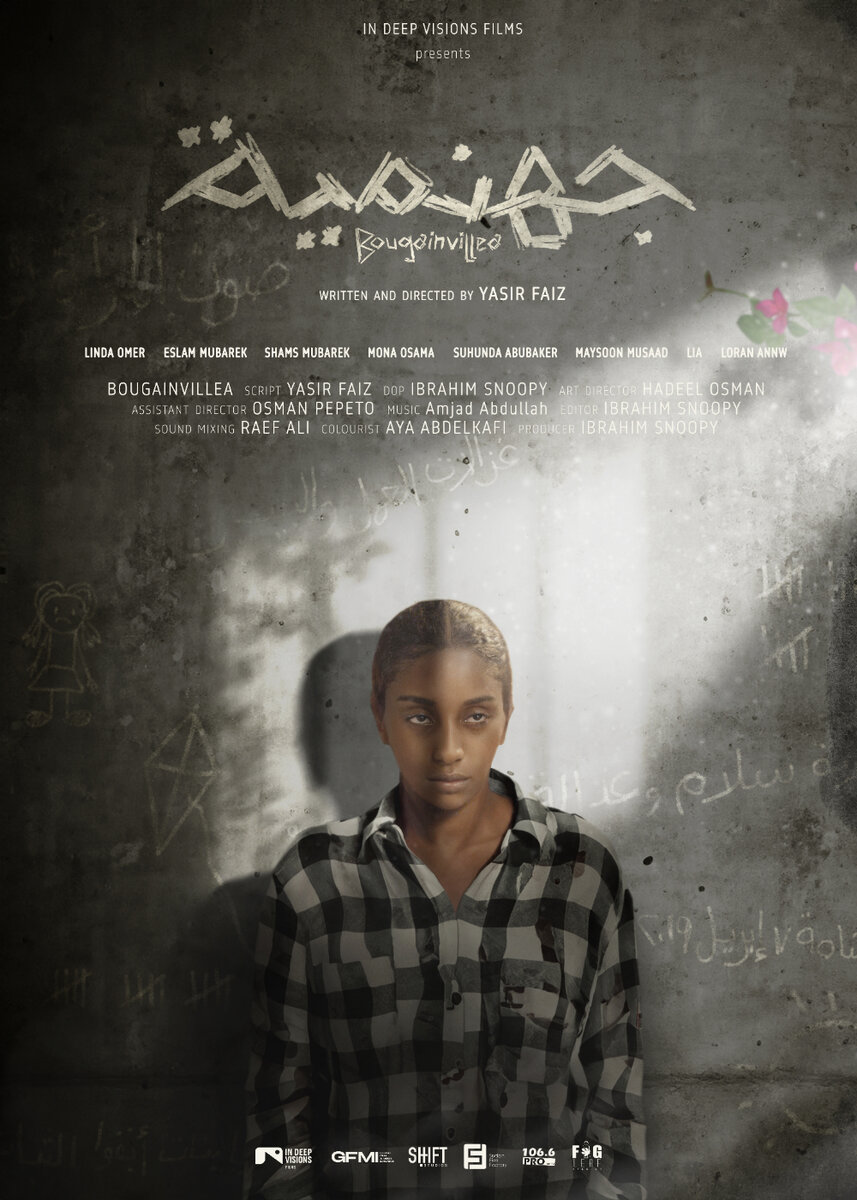
Despite the immense challenges facing the filmmakers, Bougainvillea was completed, premiering at Canada’s Middle East and North Africa Film Festival in January 2025. The film’s distribution is handled by MAD Solutions, a Pan-Arab independent studio based in Egypt, known for critically-acclaimed films, such as Oscar-nominated Theeb (2014). The company has acquired a number of films that, similar to Bougainvillea, were made in collaboration with the film institute Sudan Film Factory, including Goodbye Julia (2023) and Al-Sit (2020).
Since its premiere early this year, it has appeared in a number of global film festivals, including the Locarno Film Festival in Switzerland, which offers a limited-time free streaming option until 31 August 2025; a welcome surprise in Sudanese cinema.
Bougainvillea stars Suhanda Abubakr, Islam Mubarak, Shams Mubarak, Maysoon Musaad, Linda Omer and Mona Osama. Aside from Islam Mubarak of You Will Die at Twenty fame, the other stars have no prior film credits. The film should be commended for establishing new Sudanese acting careers, if for no other reason, as it expands narrative possibilities for Sudanese cinema.
The Review
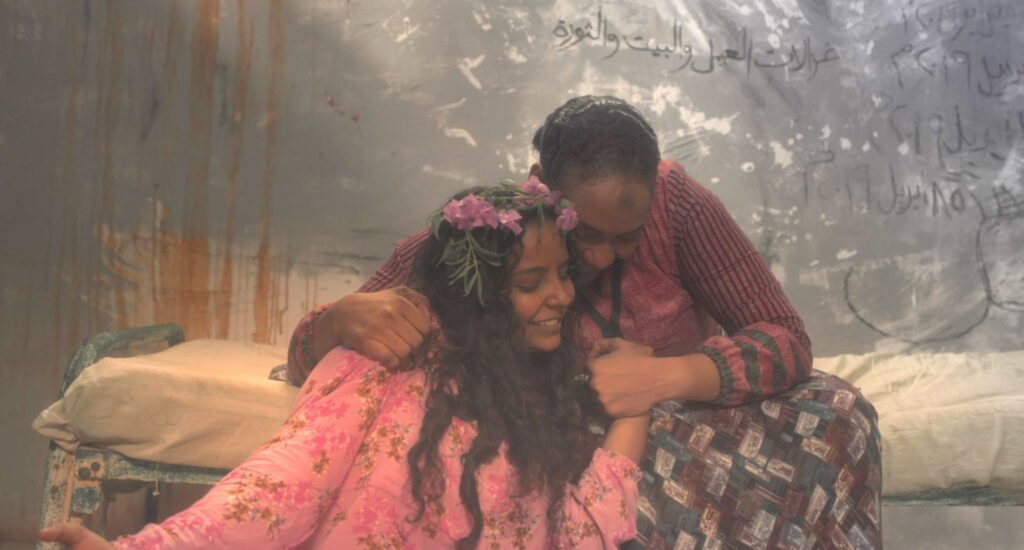
Shuhanda Abubakr (left) and Islam Mubarak (right) during a scene in Bougainvillea.
Image courtesy: Yasir Faiz
Bougainvillea’s very concept is compelling. Previously, Sudanese director Mohamed Kordofani explored the topic of incarceration in Kejer’s Prison (2019), but from a prison guard’s point of view. Faiz’s shift to the perspective of female revolutionaries, whose organising role was central in Sudan’s civilian uprisings, is welcome and overdue. The film’s portrayal of the challenges faced by female detainees represents a story largely neglected in Sudanese art, reflecting Faiz’s commitment to realism and stories about the disenfranchised.
The 17-minute film captures the government’s violence against women during the revolution. It celebrates their capacity to create joy and community amidst oppression, and their achievement in bringing down Sudanese President Omar Al Bashir in April 2019. There is a visible effort to engender the audience’s sympathy for the characters, and Sudanese women generally, by highlighting their kindness to each other and their suffering during detainment. If nothing else, the film is a commemoration of their revolutionary solidarity.
Faiz’s use of the bougainvillea, a characteristic flower of Khartoum’s urban environment and across Sudan, is also inspired, and he meaningfully incorporates it into the film’s romantic tragedy. In contrast to the usual emphasis on dialogue, the film’s bougainvillea scenes focus on visual allusions and mystical imagery, rewarding attentive viewing, especially in its moving finale. Recent narrative films, such as You Will Die at Twenty (2019) and aKasha (2018), have also used surreal visuals, but without the direct narrative relevance Bougainvillea gives to these scenes.

A scene from the film where a cast member sees a bougainvillea grow through the bars of a jail cell.
Image courtesy: Yasir Faiz
Added to the fact the film marks the entrance of new Sudanese filmmakers and actors into the industry, Faiz’s work should be appreciated as another step forward in contemporary Sudanese cinema that broadens its narrative and aesthetic horizons.
However, aside from Islam Mubarak’s grounded, emotive performance, the rest of the cast is noticeably inexperienced, which occasionally undercuts some dramatic moments. Repetitions and heavy-handed exposition can sometimes detract from Bougainvillea’s realism. These issues are not unique to the film: they permeate throughout Sudanese cinema, due to a still-small pool of experienced actors and screenwriters.
A more critical viewer may also notice some gaps in the screenplay’s characterisation. While the film attempts depth by providing each inmate a backstory and personal relationships, it doesn’t explain their motivation to revolt. The narrative focus is primarily on their suffering, survival, and achievements in April 2019, missing the opportunity to flesh out their inner thoughts and deepen understanding of Sudanese women’s resistance on an ideological level. Without this context, the film feels like a straightforward celebration of perseverance despite victimhood, rather than an appreciation of the inmates’ political subversiveness. The film’s length may play a role: Bougainvillea is ambitious in concept, addressing a sensitive and multifaceted topic, and its short runtime likely contributes to its more simplistic approach.
The film’s celebratory tone and emphasis on resilience can also feel a bit hollow, considering the aftermath of the revolution and the devastating decline in Sudanese livelihoods. This past year has seen documentaries such as Khartoum (2025) and Sudan, Remember Us (2024) reckon with the revolution alongside the current civil war. Bougainvillea’s political positivity feels comparatively outdated, although it does succeed as an accurate reflection of 2019’s revolutionary idealism.
The film may not nuance the conversation around the revolution, particularly the ideological foundations of Sudanese women’s struggle. It does, however, keep it alive by providing perspectives that are usually absent from the screen, creating space to recognise Sudanese women’s political contributions and their unique challenges. The task of understanding the political thought of Sudanese women is still best left to Sudanese women themselves, who, thus far, have preferred documentary over narrative cinema as a format to convey their struggle for liberation.
Overall, despite some weaknesses, Bougainvillea remains a worthwhile watch for its unconventional story, creative visuals, and the new themes it brings to Sudanese narrative cinema. Its production is a triumph over seemingly impossible odds, and continues an ongoing shift in Sudanese cinema to stories centring women, in the line of films like Cotton Queen (2025) and Goodbye Julia (2023). For that, it should be celebrated as the contribution that it is.

500WM Columnist Hatim Eujayl is a Sudanese-American writer involved in various projects to promote Sudanese culture. His most famous works include the Sounds of Sudan YouTube channel, the Geri Fai Omir Kickstarter, and the Sawarda Nubian font. More of his writing can be found on his Substack, ‘My Sudani-American LiFE,’ where he discusses Sudanese literature and cinema. He can be reached on Instagram @massintod or by email at [email protected].