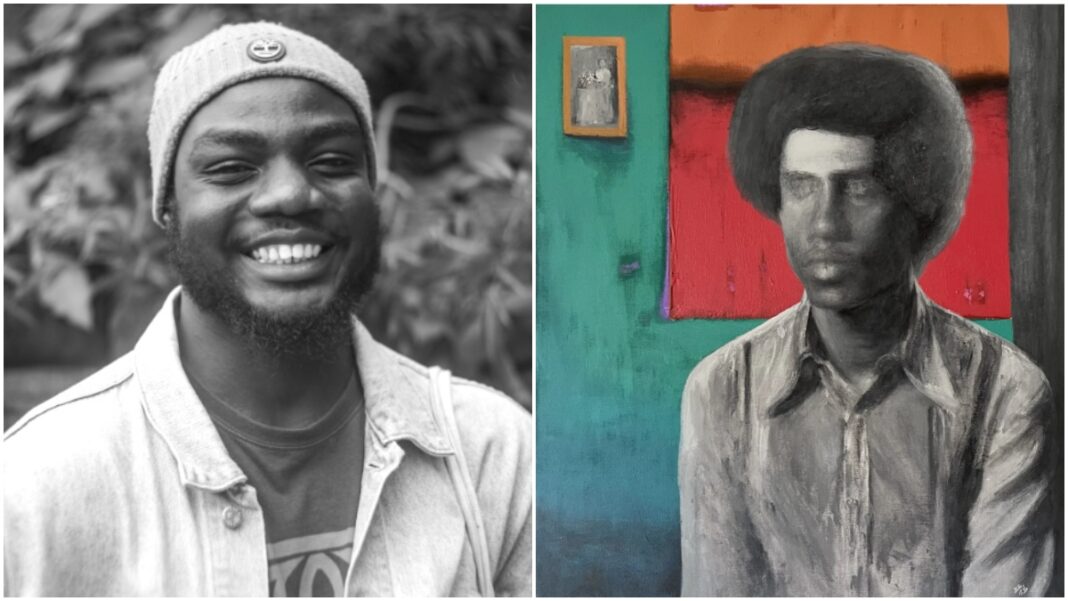
With two solo exhibitions and several other collective exhibitions already under his belt, it would be difficult to try and summarise the artistic journey of 26-year-old Sudanese artist Waleed Mohammed; nevertheless, memory proves to be a vital point to understanding his art.
The painter had several art exhibitions in galleries across the Middle East and Africa (MEA) region, including Doha, Qatar; Cairo, Egypt; Kampala, Uganda; Nairobi, Kenya; and of course, his hometown, Khartoum, Sudan. Like many of his Sudanese contemporaries, Mohammed was forced to flee Khartoum after war broke out in the country in 2023. Nevertheless, his passion for his craft enabled him to push beyond the adversaries after fleeing to Nairobi, Kenya, and later hosting his second solo exhibition in Kampala, Uganda in August 2025.
Moreover, for his compelling work, Mohammed was among more than 20 artists featured in the newly updated art book Sudan Retold. The publication is presented by Almas Art Foundation, with Georgetown University in Qatar and Alhosh Gallery as publishing partners. Launched in September 2025, the book is edited by German ethnologist Larissa-Diana Fuhrmann, Sudanese artist Khalid Albaih, and Sudanese-Russian researcher and filmmaker Suzannah Mirghani.
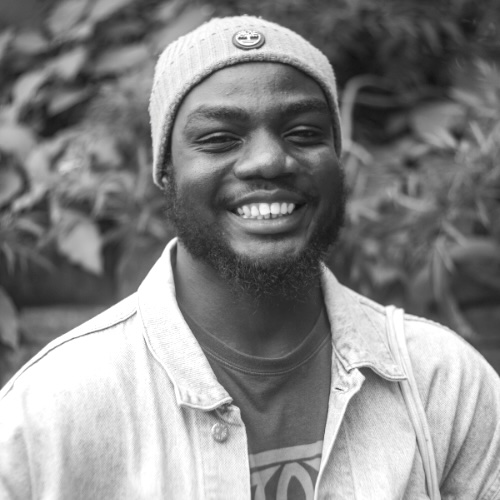
Born to Sudanese parents in Khartoum, Sudan in 2000, and now based in Nairobi, Kenya, Mohammed integrates themes of identity, memory and personal family history into his artwork. He graduated with a degree in Fine and Applied Arts from Sudan University of Science and Technology in 2023.
Waleed Mohammed sat down with The Sudanist as part of the “The Face Behind the Canvas” series to discuss his artistic journey and achievements, adjusting to life post-war, his recent inclusion in the new edition of Sudan Retold, and his upcoming projects.
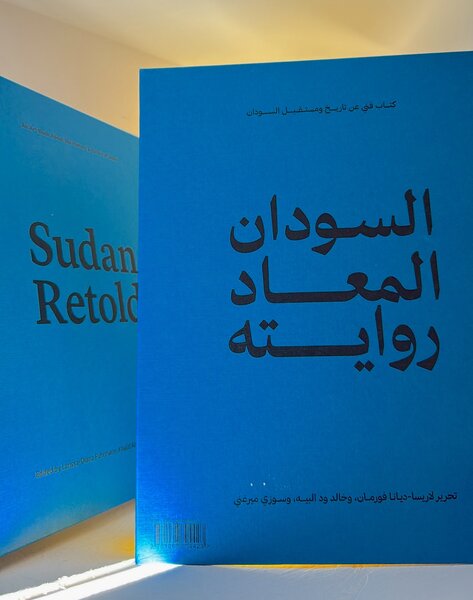
Congratulations on being featured in Sudan Retold. How do you feel about being included in such a project?
Actually, the work on the book started way back in 2022 before the war. When I was first contacted by Khalid Albaih in 2022, there was huge excitement. Then the war broke out and the project was put on hold. I, myself, had stopped working due to the war situation and was unable to access my studio in Alarabi, Khartoum. Then I reinstated in Nairobi and talked to Albaih about the project.
I would say there is an air of excitement surrounding the project, especially it being a project that started pre-war. There is also a sense of responsibility towards the project.
You are one of many artists featured in the book. What is the idea or concept behind the artwork you contributed?
It is an art book, and it contains different artists with different projects and artistic views. My own project was about faces from the studio, as my work centres on portraits from the 1960s, 1970s and early 1980s. These portraits always inspire me to dig deep into the historical narratives surrounding identity and memory.
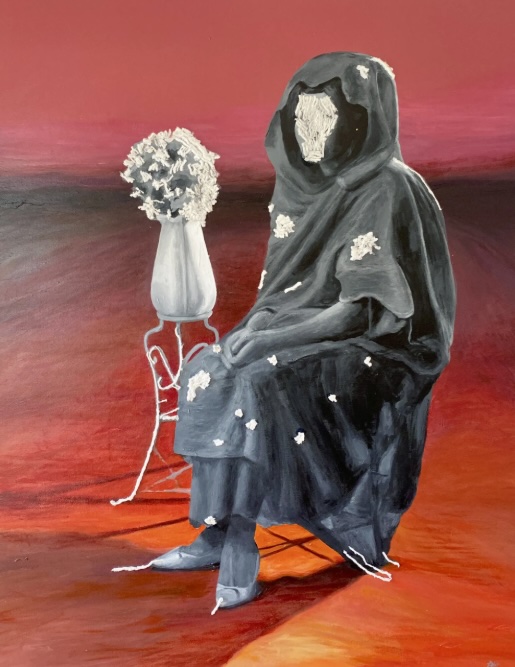
Memory is a fundamental entry to understanding your artwork. What is the link between memory and these portraits of yours?
There may not be a clear relationship between the two as these portraits of mine are kind of distorted. I do not focus on the facial features in an attempt to connect with the audience, like viewers come and comment saying, “Oh this looks like my father, mother etc.,” because of the smudged features. I try to explore the collective memory and create a universal interaction rather than just a personal one.
Art is a great way of documentation of events and non-events alike. How does art affect the collective memory of a generation and help preserve it?
I think art in general serves as a tool for documentation. It opens pathways of knowing what has changed and what has stayed the same and allows people to discuss these subjects. For example, I am currently working on a project named The Ones Who Stayed, and it is still in development. There is currently an art installation that I am working on called The Ministry of Freedom. It is related to pictures of the applicants for visas in the French embassy in Khartoum. Then war broke out and their visas were unable to proceed. I had a French friend who had access to some of the documents before their destruction and helped me process some of the pictures. Through this installation, I provide the audience with the opportunity to discuss these portraits while also telling the stories of these applicants. I think this is my role to highlight and tell these stories to the public.
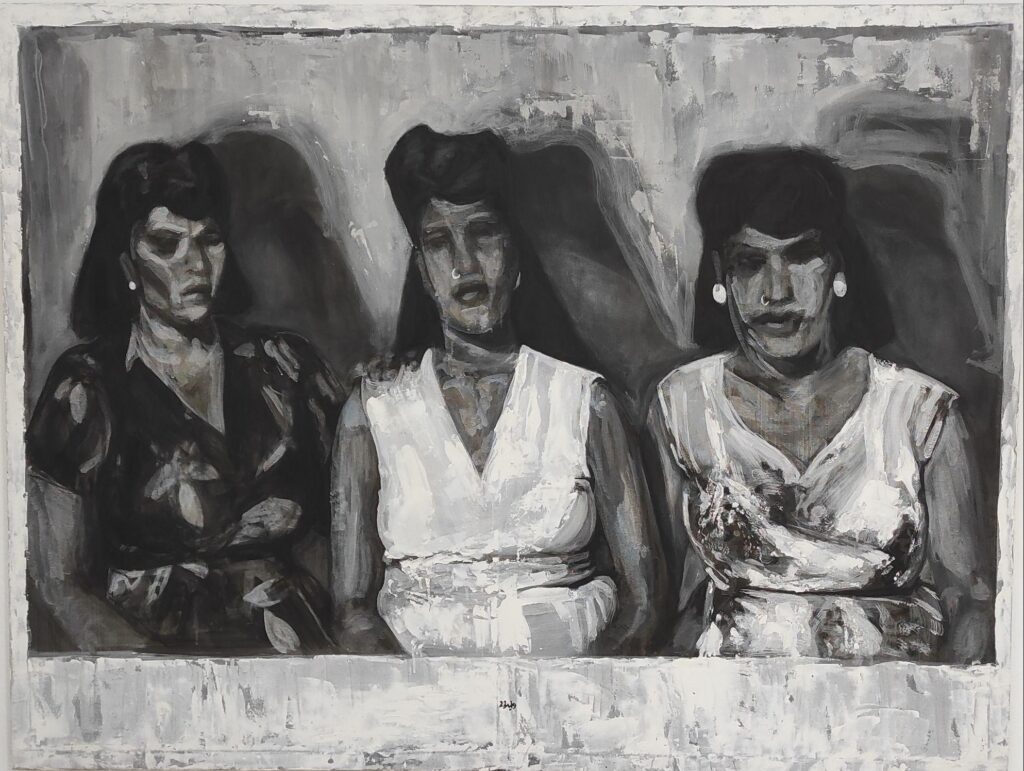
Untitled by Waleed Mohammed
You are a co-founder of the art collective, Shilla, which in colloquial Sudanese means a group of friends, in Nairobi, Kenya that includes several projects including that of The Ministry of Freedom. How did the collective come to fruition?
It was formed due to a need of ours as artists in exile to combine our efforts as we think art is a collective effort especially in the current circumstances.
What does it ask of its members and its audience?
It asks us to cooperate as artists and form a shilla – meaning a group of friends in the colloquial Sudanese dialect – before being a group of artists. We seek that the artist adds to the collective and vice versa, and we are seeing its results as artists and as an audience.
I want to discuss a painting of yours that caught my eye, Forever Grateful to Have Stumbled Upon You xx, of your mother. Describe the mother-son relationship that gives this painting its context.
I see you have done your research [laughs]. This painting is really priceless to me and represents several aspects including the mother-son relationship and a personal aspect as well. Motherhood in itself is really interesting, and its effects go beyond our childhood; how it affects us and how it builds our characters today. I connect this relationship with how I interact with myself, with my mother, with women in particular and with people in general.
The name comes from a note given to me by a friend of mine. We were drinking coffee and decided to draw quick sketches and interchange them and keep them as a memory. She wrote this line and gave it to me. I went home and thought about my relationship with myself and my relationship with my friend and found the connection between them and the painting.
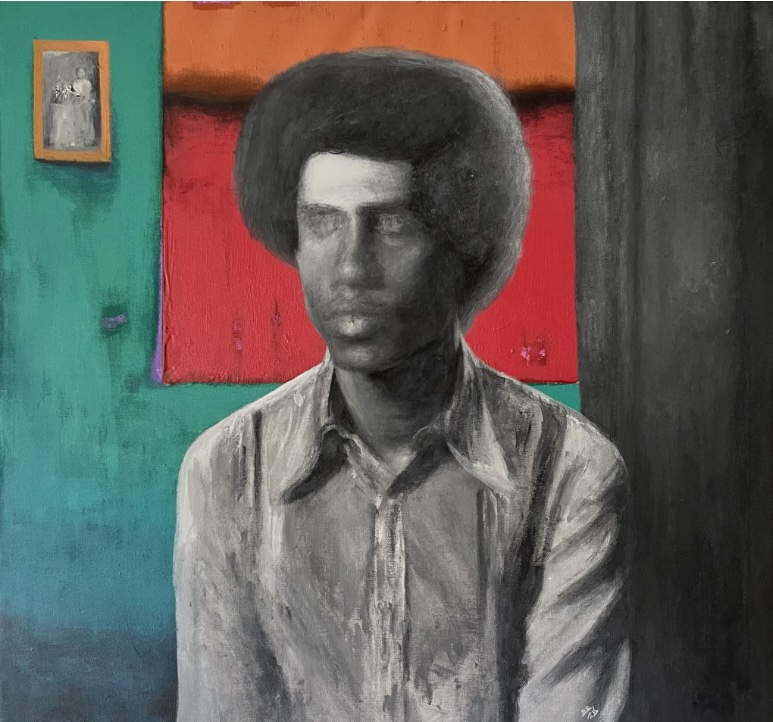
In August 2025, you had your second solo exhibition. What does it mean to commemorate your career as an artist so far with such a milestone?
I am so grateful that I was able to make this solo exhibition. My first solo exhibition was in January 2022, Khartoum, Sudan. The importance of such events means a lot to me as an artist. There is a certain value in these things that only artists can appreciate, because the circumstances that created the exhibitions are known to the artist only. The first exhibition was very important and provided a great learning experience, and I benefited from it greatly.
The second one was done during my artistic residency at 32 Degrees East in Kampala, Uganda. I never planned to make a solo exhibition when I packed my bags in Nairobi going to Kamapala. I think it was also an important milestone for me. I was able to reevaluate my journey and how far I have come since my first solo exhibition. The Ones Who Stayed art installation was first previewed there along with a sound installation in collaboration with a Ugandan-Canadian filmmaker. It included the effects of war and the results of war. So, I am very grateful to have been able to hold these two exhibitions.
Lastly, what projects are you currently working on and what can we expect from you in the near future?
I am currently working on the documentation of my family archival photos. I focus a lot on documenting photos from different time-scapes. At first, I was working on Mahdist photos, then I realised I had my own history to write down. It is an ongoing project that develops with me as I grow, and it needs more time to achieve a meaningful status for the artist first, before the audience.
You may find Waleed Mohammed’s artwork at Sudan Art Archive, Latitudes, Prazzle Arts and on social media: Instagram @artistwaleedmohammed.
As he ventures into this brave new world ahead of him, 2005-born Muathal Hisham tries to reflect on the experiences he encounters through poetry and prose. An aspiring bilingual essayist who aims to reinvent the way literature, art and music are interpreted, Muathal provides a thrilling dive into regional and international cultures, with the hope it might inspire positive change in his community. When he is not writing, Muathal is often busy video editing or studying for medical school at Ain Shams University. Find him @muathall on Instagram or visit his blog on Medium at @Muathal.